NZ Paye & Take-Home Pay Calculator
Best NZ PAYE Calculator 2026 & 2027
Your details
0%3.5%10%Student loanIndependent earner creditAnnualTake-home pay$00% of gross incomeAnnualPAYE tax$0Effective rate: 0%AnnualKiwiSaver$0Employee contributionAnnualACC levy$01.75% of liable earningsAnnualGross income$0Before any deductionsAnnualStudent loan$0Not applicableTax breakdown
Total deductions$0Income vs deductions
Total income$0Pay breakdown
Gross income $0 Income tax (PAYE) −$0 Independent earner tax credit +$0 ACC earners' levy −$0 KiwiSaver contribution −$0 Student loan repayment −$0 Take-home pay $0 Tax brackets in play Marginal rate: 0%10.5%17.5%30%33%39%
Use our free NZ PAYE Calculator to accurately calculate your net salary, PAYE tax, KiwiSaver contributions, ACC levy, student loan repayments, and take-home pay. Whether you’re paid weekly, fortnightly, monthly, or annually, this NZ paye calculator uses the latest NZ Inland Revenue (IRD) tax rates to provide fast, reliable payroll estimates for employees, contractors and job seekers across New Zealand.
What is PAYE in New Zealand?
PAYE – Pay As You Earn is the tax system used in New Zealand to collect income tax from employees’ wages and salaries. employer deducts PAYE from gross pay before paying salary and sends the deduction to Inland Revenue -IRD on your behalf. The amount deducted depends on factors such as your income, tax code and applicable deductions.
How nz Paye calculator works
Our New Zealand PAYE Calculator converts your gross salary into an accurate estimate of your take-home pay by calculating PAYE income tax, ACC earner’s levy, KiwiSaver contributions, and student loan deductions using the latest Inland Revenue (IRD) rules. It supports annual, monthly, fortnightly, weekly, and hourly income calculations for employees across New Zealand.
Enter your salary.
Add your gross income to Tax Calculator
Select option of Annual, monthly, or weekly.
Plus any secondary income and your KiwiSaver rate.
Apply the 2026/27 tax brackets.
Your income is taxed progressively across all five Inland Revenue brackets — 10.5%, 17.5%, 30%, 33% and 39% — plus the ACC earners’ levy of 1.75%.
See your exact take-home pay.
Get a full breakdown — income tax, ACC levy, KiwiSaver, student loan and the Independent Earner Tax Credit where it applies.
How Is PAYE Calculated in New Zealand?
PAYE is calculated by applying New Zealand’s progressive tax brackets to each portion of your income, then adding the ACC earner’s levy, and subtracting any tax credits you qualify for. The formula is:
PAYE = (Income tax across all applicable brackets) + (ACC earner’s levy) − (Tax credits, e.g. IETC)
Because the system is progressive, a higher bracket only taxes the income that falls inside it — not your entire salary.
Step-by-step formula breakdown:
- Apply each tax bracket to only the income within that band (see table below).
- Sum the tax owed across all applicable bands = your PAYE income tax.
- Add the ACC earner’s levy: Gross income × 1.75% (capped at the maximum liable earnings threshold).
- Subtract the Independent Earner Tax Credit (IETC) if your income is between $24,000–$70,000 and you don’t receive Working for Families or certain benefits: up to $520/year, abating above $66,000.
- Deduct KiwiSaver (if applicable): Gross income × your contribution rate (e.g. 3.5%).
- Deduct student loan repayments (if applicable): (Gross income − $24,128) × 12%.
- Net/take-home pay = Gross income − PAYE − ACC levy − KiwiSaver − Student loan (+ any tax credit applied).
NZ Income Tax Brackets 2026/27
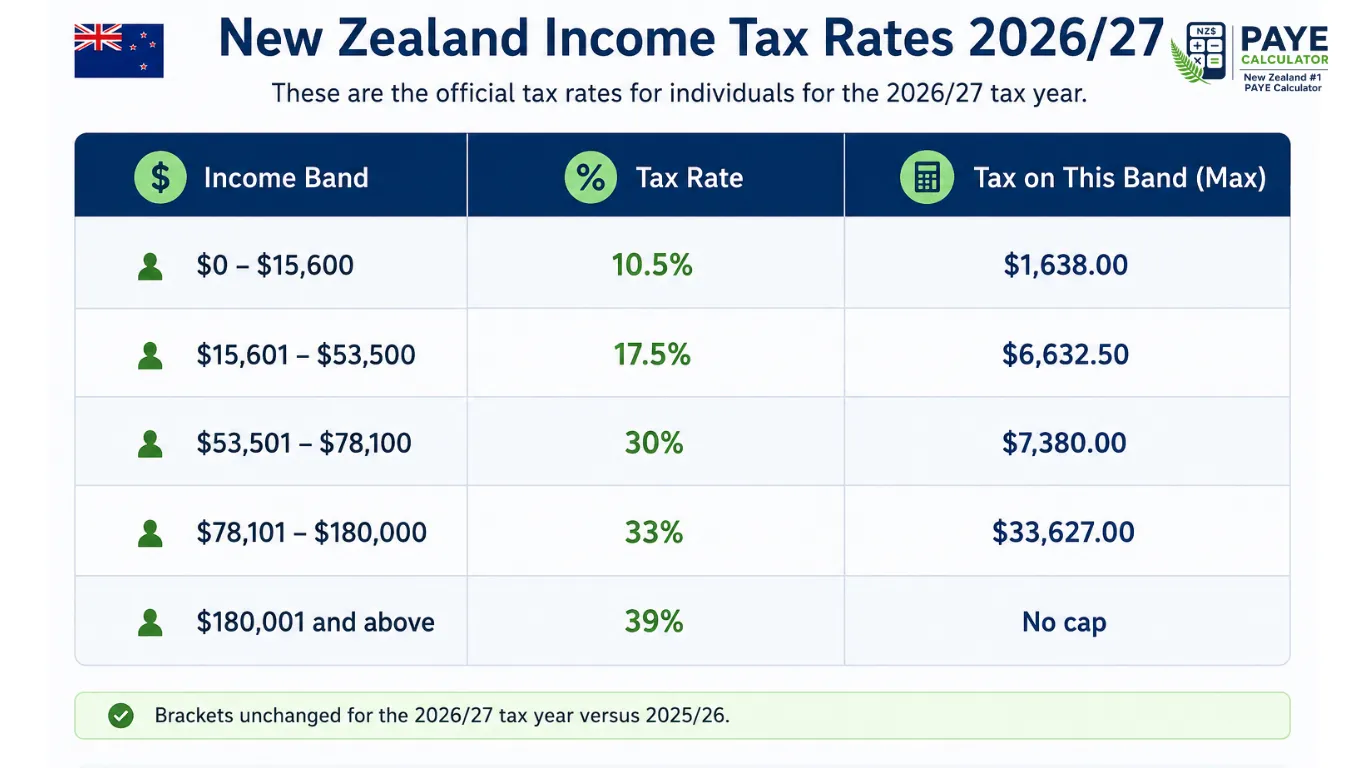
New Zealand taxes income progressively under Inland Revenue’s rules — you only pay the higher rate on the portion of income inside each band, not your entire salary. These thresholds took effect 1 April 2025 and carry through unchanged for the 2026/27 tax year.
- Worked example — $70,000 salary:
- 10.5% on first $15,600 = $1,638.00
- 17.5% on next $37,900 ($15,601–$53,500) = $6,632.50
- 30% on remaining $16,500 ($53,501–$70,000) = $4,950.00
- Total PAYE income tax = $13,220.50
- Effective tax rate ≈ 18.9% (even though the marginal rate on the next dollar is 30%)
Your marginal rate (tax on your next dollar) is always higher than your effective rate (total tax ÷ total income) Mean a pay rise is never “taxed away” because only the portion inside the new bracket is taxed at the higher rate.
ACC Earner’s Levy — What It Is and How Much You Pay?
The ACC earner’s levy funds New Zealand’s no-fault accident compensation scheme and is deducted automatically alongside PAYE. For the 2026/27 tax year, the rate is 1.75% of gross earnings (up from 1.67% in 2025/26), capped at a maximum liable earnings threshold of $156,641 — meaning the most anyone pays annually is $2,741.22, regardless of how much more they earn.
Worked example: On a $75,000 salary, the ACC levy is
$75,000 × 1.75% = $1,312.50per year, or roughly $50.48 per fortnight.
KiwiSaver Deductions Through PAYE
If you’re a KiwiSaver member, your contribution is deducted directly through PAYE at your chosen rate — 3.5% the new 2026 default, or optionally 4%, 6%, 8%, or 10%. Your employer generally matches your rate up to the default minimum. This is a separate deduction from income tax and doesn’t affect your PAYE bracket calculation — it comes off your take-home pay after tax.
Worked Example: On a $75,000 salary at the 3.5% default rate:
$75,000 × 3.5% = $2,625deducted from your pay, matched by a further $2,625 from your employer (subject to Employer Superannuation Contribution Tax on the employer side).
Student Loan Repayments Through PAYE
If you have a New Zealand student loan and earn above the repayment threshold, 12 cents of every dollar above that threshold is automatically deducted through PAYE. For 2026/27, the threshold remains $24,128 per year, unchanged from the prior year.
Worked example: On a $50,000 salary:
($50,000 − $24,128) × 12% = $3,104.64in annual student loan repayments, or roughly $119.41 per fortnight.
Real-World PAYE Examples at Different Salary Levels
| Gross annual salary | PAYE income tax | ACC levy (1.75%) | Effective tax rate | Approx. take-home (excl. KiwiSaver/student loan) |
|---|---|---|---|---|
| $50,000 | $6,632.50 | $875.00 | 15.0% | ~$42,493 |
| $70,000 | $13,220.50 | $1,225.00 | 20.6% | ~$55,555 |
| $80,000 | $16,277.50 | $1,400.00 | 22.1% | ~$62,323 |
| $100,000 | $23,157.50 | $1,750.00 | 24.9% | ~$75,093 |
| $150,000 | $46,857.50 | $2,625.00 | 33.0% | ~$100,518 |
(Figures show PAYE + ACC only, before any KiwiSaver, student loan, or IETC adjustments, to isolate the core tax calculation. Add your own KiwiSaver rate and student loan status using the calculator above for a complete picture.)
Someone comparing a $70,000 job offer against an $80,000 offer often assumes the difference is a straightforward extra $10,000 in the bank. In reality, the extra $10,000 is taxed at 30% up to $78,100 and 33% above that, plus an extra $175 in ACC levy — meaning the real after-tax gain is closer to $7,057, not $10,000. This is exactly the kind of comparison a PAYE calculator is built to make concrete rather than estimated by feel.
Related calculators
Explore our complete collection of New Zealand financial calculators, including the Hourly to Salary Calculator, KiwiSaver Calculator NZ, and Student Loan repayment Calculator for fast and accurate financial planning.
Disclaimer: This calculator provides general estimates for common salary/wage situations and is not personalised tax advice. Your actual PAYE deduction can differ based on tax code, secondary income, ACC exemptions, or IRD adjustments.
visiting IRD Website for more information.
Frequently Asked Questions
Am I eligible for the Independent Earner Tax Credit?
You may be eligible if your annual income is between $24,000 and $70,000, and you don’t receive Working for Families tax credits, an income-tested benefit, NZ Super, or a veteran’s pension. The credit is worth up to $520/year and reduces between $66,000–$70,000.
What is the student loan repayment threshold in New Zealand?
The student loan repayment threshold is $24,128 per year for 2026/27, unchanged from the previous year. Income above this threshold is repaid at 12%.
Does KiwiSaver reduce my taxable income?
No. KiwiSaver contributions are deducted from your pay after PAYE income tax is calculated — they do not reduce your taxable income the way. For example, a pre-tax retirement contribution might in some other countries.
What is the difference between marginal and effective tax rate?
Your marginal tax rate is the rate applied to your next dollar earned (e.g., 30% for someone earning $70,000). Your effective tax rate is your total tax paid divided by your total income (e.g., about 18.9% for that same person) — always lower than the marginal rate because lower brackets are taxed at lower rates first.
Is PAYE the same as income tax?
PAYE (Pay As You Earn) is the withholding method your employer uses to deduct income tax, ACC levy, KiwiSaver, and student loan repayments directly from your pay each payday. Income tax is one component of what PAYE withholds, not a separate tax.
What is the ACC earner’s levy rate in 2026?
The ACC earner’s levy is 1.75% of gross earnings for the 2026/27 tax year, up from 1.67% the previous year, capped at a maximum liable earnings threshold of $156,641 (maximum annual levy: $2,741.22).
What are the NZ tax brackets for 2026-27?
Five bands apply:
10.5% up to $15,600
17.5% up to $53,500
30% up to $78,100
33% up to $180,000
39% above $180,000
These are unchanged from the 2025-26 tax year.
How can I calculate PAYE?
You can calculate PAYE by implementing progressive income tax rates of New Zealand to your gross income and then accounting for any additional payroll deductions, such as the ACC Earner’s Levy, KiwiSaver contributions and student loan repayments if applicable. The most accurate method is to use an New Zealand PAYE Calculator, which automatically applies the latest Inland Revenue (IRD) tax rates and deductions to calculate your take home pay.
How much PAYE will I pay on $300,000?
For the 2026-2027 New Zealand tax year, an annual income of NZ $300,000 falls into the highest 39% marginal tax bracket. But you do not pay 39% tax on your all salary. New Zealand uses a progressive tax system, meaning each portion of your income is taxed at the rate for that income band. Your total PAYE depends on your tax code, KiwiSaver contribution rate, ACC Earner’s Levy and any applicable student loan deductions.