How to Read a Payslip In New Zealand: Every Line Explained
A typical NZ payslip shows your gross pay, then itemised deductions — PAYE (income tax + ACC levy combined), KiwiSaver, and student loan if applicable — before arriving at net pay, the amount actually deposited into your account. Genuinely surprising fact: payslips aren’t legally mandatory in New Zealand unless your employment agreement specifically requires one.
Check your own numbers add up correctly using our free PAYE Calculator.
Table of Contents
Wait — Are Payslips Even Legally Required in NZ?
Answer block: No, surprisingly. There’s no single law stating “employers must issue a payslip every payday.” What is legally required is that employers keep accurate wage and time records (under the Employment Relations Act 2000) and leave records (under the Holidays Act 2003), and make them available to an employee on request. In practice, issuing a clear payslip each pay period is simply the easiest, most common way employers meet this obligation — which is why the vast majority of NZ employers provide one anyway, even though no specific “Payslip Act” compels it.
(Source: Employment New Zealand — Pay and wages.)
If you don’t receive a payslip, or yours is missing information, you have the right to ask your employer directly for your wage and time records — this is a legal entitlement, regardless of whether a formal payslip document exists.
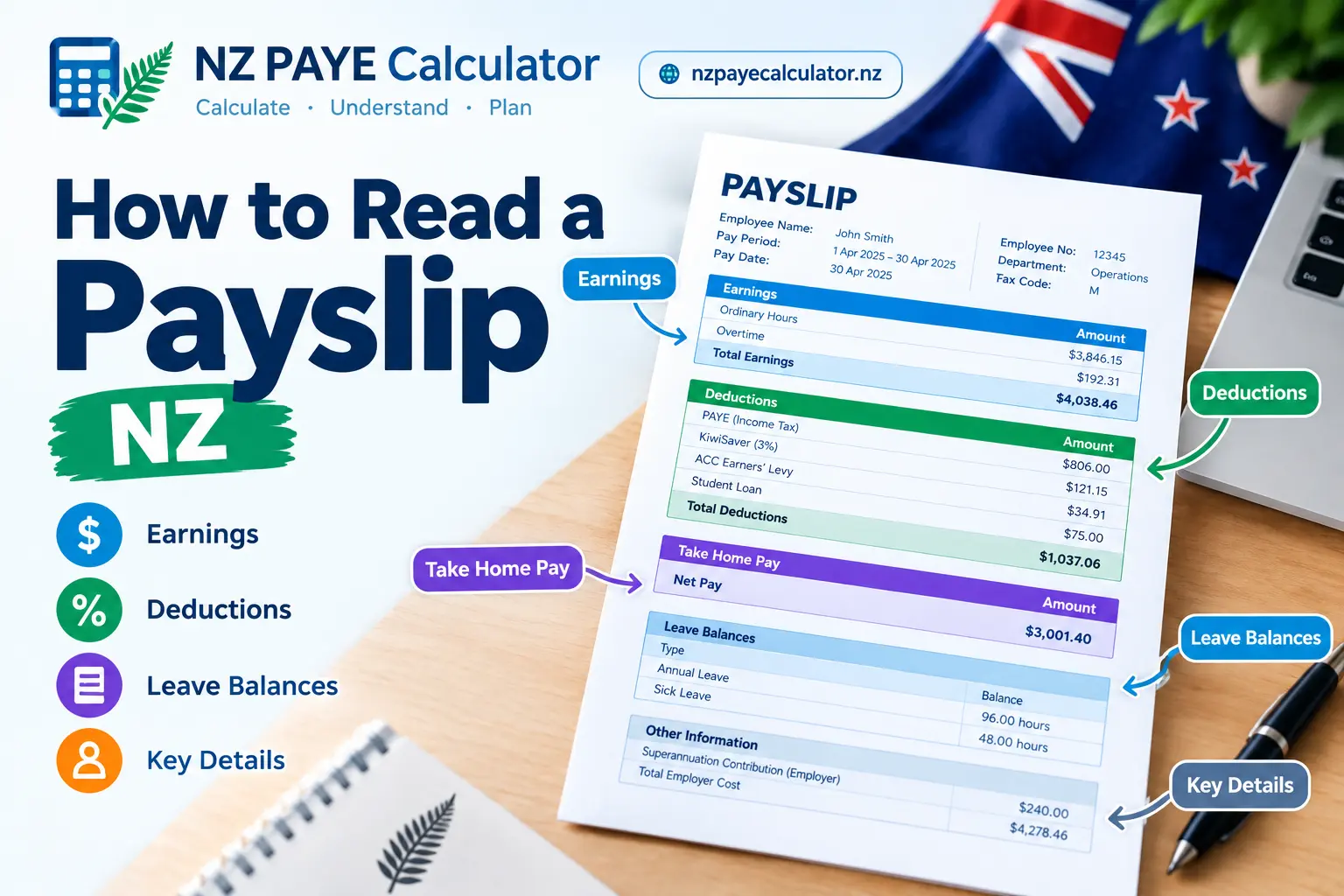
Every Line on a Standard NZ Payslip, Explained
| Payslip line | What it means |
|---|---|
| Pay period | The specific date range this payslip covers (e.g., “1–14 September 2026”) — not to be confused with the pay date, which is when the money actually arrives |
| Pay date | The actual date the payment is deposited into your account |
| Gross pay | Your total earnings for this specific pay period, before any deductions |
| Ordinary hours / rate | For hourly employees, the standard hours worked and the base rate applied |
| Overtime | Any hours paid at a premium rate, shown separately from ordinary hours |
| Allowances | Extra payments for something specific (travel, tools, on-call) — not legally required, but common in many industries |
| PAYE | Combined income tax + ACC earner’s levy, since IRD’s official deduction tables blend these into one figure |
| KiwiSaver (Employee) | Your own contribution, deducted from your pay |
| KiwiSaver (Employer) | Your employer’s matching contribution — shown for transparency, but not deducted from your pay |
| ESCT | Employer Superannuation Contribution Tax — the tax your employer pays on their KiwiSaver contribution (see below) |
| Student Loan | 12% of income above the threshold, shown separately if you have an SL-suffixed tax code |
| Other deductions | Union fees, court-ordered deductions, workplace savings schemes |
| Net pay | The final take-home amount — what actually lands in your bank account |
| YTD (Year-to-Date) figures | Running totals of gross pay, tax, and deductions since the start of the tax year (1 April) |
| Leave balances | Annual leave, sick leave, and sometimes alternative holidays accrued and remaining |
The Line Almost No One Understands — ESCT
ESCT (Employer Superannuation Contribution Tax) is tax your employer pays on the KiwiSaver (or other superannuation) contribution they make on your behalf — it has nothing to do with your own pay or your own KiwiSaver contribution. You might see it referenced on a detailed payslip, but it’s a cost to your employer, calculated based on your total earnings, and doesn’t reduce your net pay at all. If you see “ESCT” and wonder why your take-home didn’t change — it’s not supposed to; this line exists purely for payroll transparency on the employer’s side of the transaction.
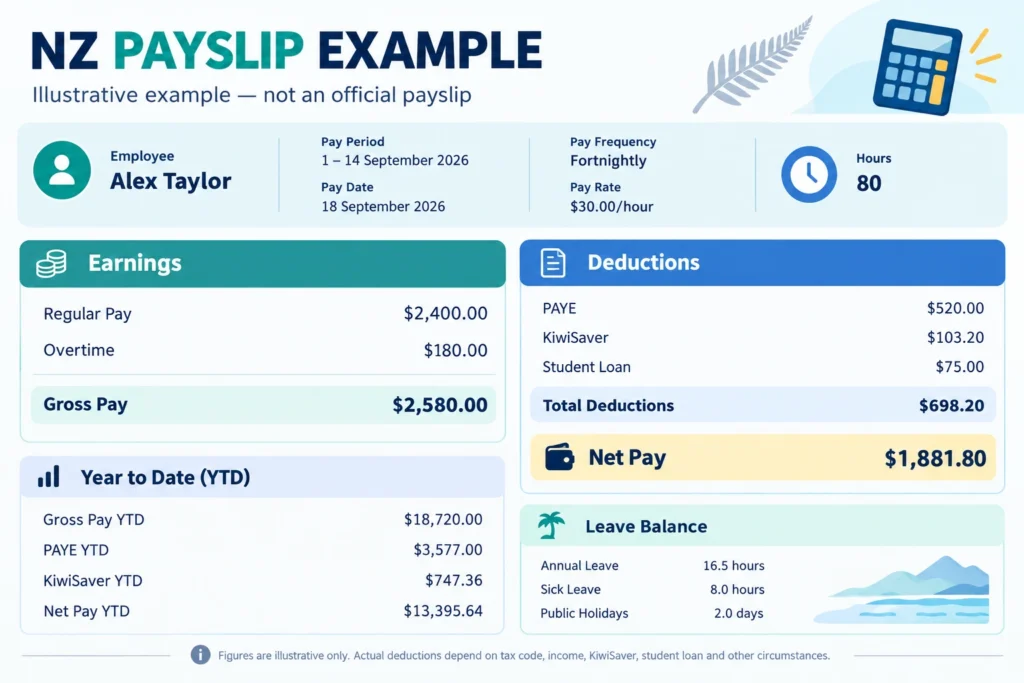
Why “PAYE” on Your Payslip Might Confuse You
Many people expect to see “income tax” as a separate line from “ACC levy” — but IRD’s own official PAYE deduction tables (IR340/IR341) combine income tax and the ACC earner’s levy into a single figure, which is why most payslips simply show one “PAYE” line rather than splitting the two out. If you want to see the exact split, use our PAYE Calculator, which breaks these out separately so you can see precisely how much of your PAYE deduction is income tax versus the 1.75% ACC levy specifically.
Worked Example — Annotated Payslip
Here’s a realistic fortnightly payslip for someone earning $75,000/year, with a 3.5% KiwiSaver contribution and a student loan:
| Line | Amount | What it represents |
|---|---|---|
| Gross pay (fortnightly) | $2,884.62 | $75,000 ÷ 26 pay periods |
| PAYE | −$556.71 | Income tax + ACC levy combined, for this pay period |
| KiwiSaver (Employee, 3.5%) | −$100.96 | Deducted from pay |
| Student Loan (12% over threshold) | −$107.02 | Based on annualised income above $24,128 |
| Net pay | $2,119.93 | Amount actually deposited |
| (Informational, not deducted) KiwiSaver (Employer, 3.5%) | $100.96 | Paid on top by employer — doesn’t reduce net pay |
| (Informational, not deducted) ESCT | ~$33.32 | Tax the employer pays on their own contribution above |
Check your own exact figures — for any salary, KiwiSaver rate, and student loan status — using our free PAYE Calculator and Student Loan Calculator.
Common Payslip Mistakes and Red Flags Worth Checking
- Wrong tax code — if you have a student loan but your payslip shows “M” instead of “M SL,” repayments won’t be deducted, creating a bill later. See our SL vs M SL Tax Code guide for the full breakdown.
- Missing KiwiSaver deduction despite being enrolled — worth flagging to payroll immediately, since it affects your government contribution eligibility too.
- Deductions you didn’t authorise — under the Wages Protection Act 1983, employers generally can’t deduct money from your pay (for till shortages, damaged equipment, etc.) without your written consent — a payslip showing an unexplained deduction is worth questioning directly.
- YTD figures that don’t reconcile — if your year-to-date gross pay doesn’t roughly match (pay period gross × number of periods so far), it’s worth asking payroll to check for an error or missed payment.
Frequently Asked Questions
Am I legally entitled to a payslip in NZ?
Not exactly — there’s no specific law requiring employers to issue a payslip. However, employers must keep accurate wage, time, and leave records and provide them to you on request, which is why most employers issue payslips as the simplest way to meet that obligation.
What does PAYE mean on my payslip?
PAYE (Pay As You Earn) on a payslip typically represents your combined income tax and ACC earner’s levy deduction, since IRD’s official deduction tables blend these into one figure rather than showing them separately.
Why does my payslip show an “Employer KiwiSaver” amount that doesn’t affect my net pay?
Because it’s informational — your employer’s KiwiSaver contribution is paid on top of your salary as an additional cost to them, not deducted from your pay, so it appears on the payslip for transparency without reducing your take-home amount.
What is ESCT on a payslip?
Employer Superannuation Contribution Tax — the tax your employer pays on the KiwiSaver contribution they make on your behalf. It doesn’t affect your own net pay.
Can my employer deduct money from my pay without asking me?
Generally no. Under the Wages Protection Act 1983, deductions from wages (beyond standard tax and KiwiSaver) generally require your written consent, except in specific legally mandated circumstances.
How long do employers have to keep payslip and wage records in NZ?
Employers are required to retain payroll records, generally for six years, and must provide access to an employee’s own records within a reasonable time of a request.
What’s the difference between pay period and pay date on a payslip?
The pay period is the date range the payslip covers (e.g., a specific fortnight worked). The pay date is when the payment actually lands in your bank account, which is often a few days after the pay period ends.
How can I get my payslip in New Zealand?
You can usually get your payslip from your employer or through your workplace payroll system, employee portal, email, or HR department. If your employer does not provide a payslip, you can ask for information about your wages, hours worked, and holiday or leave records.
New Zealand employers must keep accurate wage, time, holiday and leave records, and employees have the right to ask to see their employment records.
A payslip may show your gross pay, PAYE tax, other deductions, net pay, hours worked, pay rate, leave information, and year-to-date amounts.
How do I make a payslip in NZ?
To make a payslip in New Zealand, include the key information needed to clearly show how an employee’s pay was calculated. A typical payslip can include:
Employee name or employee number
Pay period and payday
Hours worked and pay rate
Gross pay
PAYE deducted
KiwiSaver contributions, if applicable
Student loan deductions, if applicable
Other lawful deductions
Holiday and leave information
Net pay
Year-to-date totals
Employers must keep accurate records of wages, hours, holidays and leave. Employment New Zealand also notes that employers can use payroll software, spreadsheets, or other record-keeping systems, provided the required records are accurate and accessible.
For calculating the difference between gross pay and take-home pay, you can also use the NZ PAYE Calculator.
Are payslips a legal requirement in NZ?
No. Payslips are not generally a legal requirement in New Zealand. An employer does not have to provide a payslip unless the employment agreement says they will.
However, employers are legally required to keep accurate wage, time, holiday and leave records. If you do not receive a payslip, you can ask your employer for the relevant information or records about your pay and leave.
So, there is an important distinction: a payslip itself is not generally mandatory, but accurate employment and wage records are.
Can an employee ask for their wage records in New Zealand?
Yes. Employees can ask to see their employment records. Employers must keep accurate records covering wages, time, holidays and leave, generally for 6 years.