$X an Hour Is How Much a Year? Full NZ Hourly to Annual Salary Table
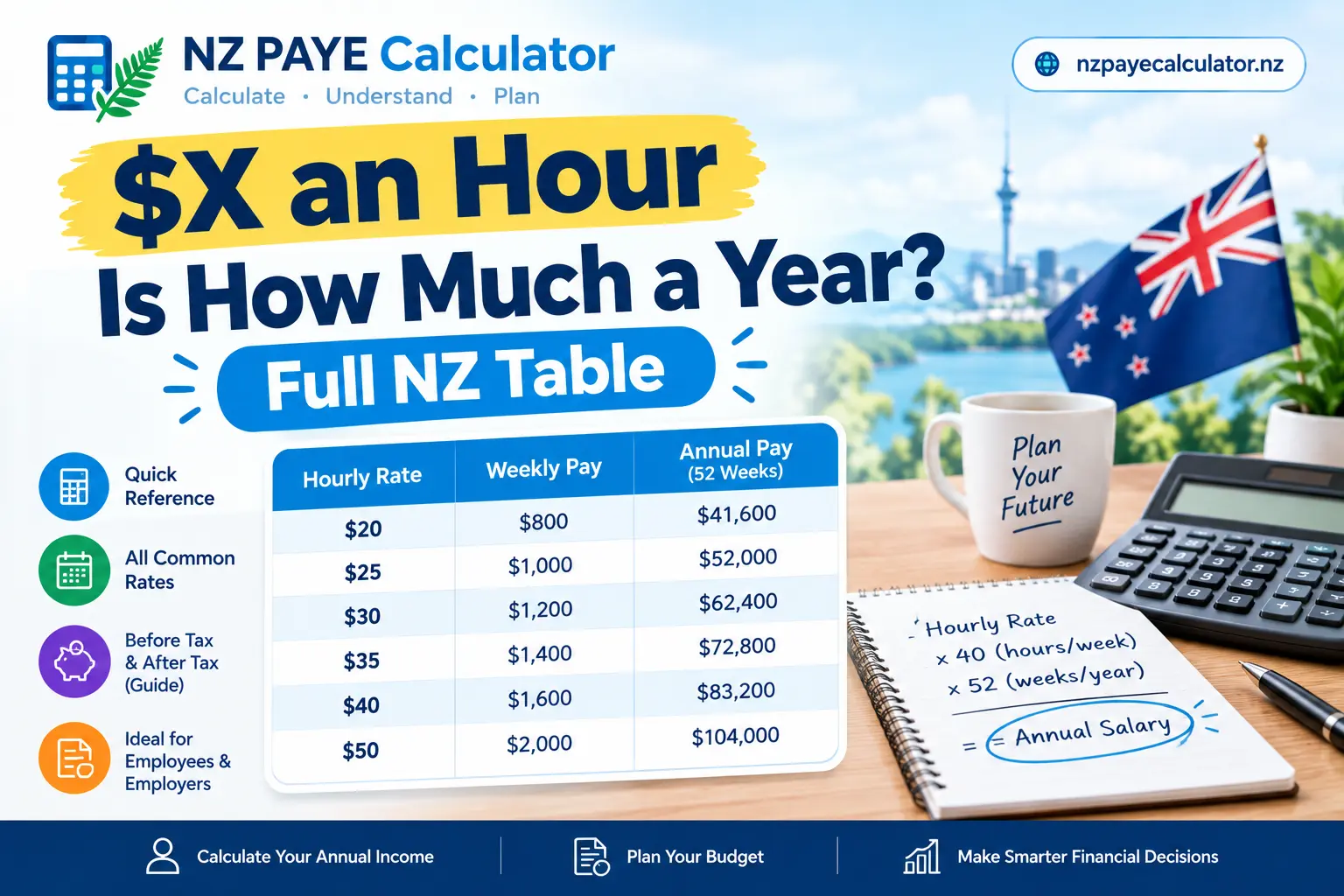
At a standard 40-hour week, multiply your hourly rate by 2,080 (40 hours × 52 weeks) to get your gross annual salary. $25/hour = $52,000/year. $30/hour = $62,400/year. $23.95/hour (the 2026 minimum wage) = $49,816/year. Full table for every common rate is below.
Convert your own exact rate using our free Hourly to Salary Calculator, then see your real take-home pay with our PAYE Calculator.
Figures below are gross (before tax) annual equivalents based on a standard 40-hour week and 52 weeks per year, unless otherwise noted. For your exact take-home pay, use the calculators linked throughout.
Table of Contents
The Formula
Annual salary (gross) = Hourly rate × Hours per week × 52 weeksAt a standard 40-hour week: Annual salary = Hourly rate × 2,080
Full Conversion Table Of Hourly to Annual salary — $18 to $65 an Hour
All figures are gross (before tax), based on a standard 40-hour week, 52 weeks a year.
| Hourly rate | Weekly (gross) | Annual (gross) | Note |
|---|---|---|---|
| $18.00 | $720.00 | $37,440 | |
| $20.00 | $800.00 | $41,600 | |
| $22.00 | $880.00 | $45,760 | |
| $23.95 | $958.00 | $49,816 | 2026 adult minimum wage |
| $25.00 | $1,000.00 | $52,000 | |
| $26.00 | $1,040.00 | $54,080 | |
| $28.00 | $1,120.00 | $58,240 | |
| $28.95 | $1,158.00 | $60,216 | Living Wage (previous, to 31 Aug 2026) |
| $29.90 | $1,196.00 | $62,192 | Living Wage (current, from 1 Sept 2026) |
| $30.00 | $1,200.00 | $62,400 | |
| $32.00 | $1,280.00 | $66,560 | |
| $35.00 | $1,400.00 | $72,800 | |
| $38.00 | $1,520.00 | $79,040 | |
| $40.00 | $1,600.00 | $83,200 | |
| $42.00 | $1,680.00 | $87,360 | |
| $45.00 | $1,800.00 | $93,600 | |
| $48.00 | $1,920.00 | $99,840 | |
| $50.00 | $2,000.00 | $104,000 | |
| $55.00 | $2,200.00 | $114,400 | |
| $60.00 | $2,400.00 | $124,800 | |
| $65.00 | $2,600.00 | $135,200 |
Don’t see your exact rate? Use our Hourly to Salary Calculator for any calculation, including decimals.
Minimum Wage and Living Wage — Not the Same Thing
These are two different, commonly confused benchmarks:
| Minimum wage | Living Wage | |
|---|---|---|
| What it is | The legal minimum employers must pay | A voluntary, independently calculated benchmark for a basic acceptable standard of living |
| 2026 rate | $23.95/hour | $29.90/hour (current since 1 September 2026; previously $28.95) |
| Annual equivalent (40hr week) | $49,816 | $62,192 (previously $60,216) |
| Legally required? | Yes | No — accredited employers opt in voluntarily |
The gap between them is substantial: $5.95/hour, or roughly $12,376/year at a standard 40-hour week — a meaningful difference worth knowing if you’re comparing a job advertised at “minimum wage” against one advertised as “Living Wage accredited.”
Does the 40-Hour Assumption Always Apply?
No — this is one of the most common sources of confusion when converting hourly rates. Many office and professional roles use 37.5 hours as their standard full-time week instead of 40, which changes the annual figure meaningfully at the same hourly rate:
| Hourly rate | Annual at 40hr/week | Annual at 37.5hr/week | Difference |
|---|---|---|---|
| $25.00 | $52,000 | $48,750 | −$3,250 |
| $30.00 | $62,400 | $58,500 | −$3,900 |
| $35.00 | $72,800 | $68,250 | −$4,550 |
| $40.00 | $83,200 | $78,000 | −$5,200 |
Always confirm your employer’s specific standard week before assuming 40 hours — the difference is large enough to matter when comparing job offers.
Gross vs. Net — What Actually Lands in Your Bank Account
Every figure in the tables above is gross — before income tax, the ACC earner’s levy, and if applicable KiwiSaver and student loan deductions. Your real take-home pay is meaningfully lower.
Example: $30/hour at 40 hours/week = $62,400/year gross. After standard PAYE, ACC levy, and a 3.5% KiwiSaver contribution, take-home pay is closer to $48,184/year — roughly 23% less than the gross figure suggests.
Use our PAYE Calculator for your own precise net figure.
Worked Examples for Three Common Searches
“$25 an hour is how much a year?” At 40 hours/week: $25 × 2,080 = $52,000/year gross. At 37.5 hours/week: $25 × 1,950 = $48,750/year gross.
“$30 an hour is how much a year?” At 40 hours/week: $30 × 2,080 = $62,400/year gross — below the ~$35/hour median wage benchmark, but comfortably above both the minimum wage ($23.95/hour) and the Living Wage ($29.90/hour).
“$40 an hour is how much a year?” At 40 hours/week: $40 × 2,080 = $83,200/year gross — well above the national median salary, typically representing a senior or specialist role.
How These Rates Compare to National Benchmarks
For context, the median hourly wage in New Zealand sits around $35.00/hour — Immigration New Zealand uses a similar figure as its median wage threshold for work visas — equivalent to $72,800/year at a standard 40-hour week, meaning roughly half of all NZ wage earners sit above this line and half below it.
Frequently Asked Questions
How do I convert an hourly rate to an annual salary in NZ?
Multiply your hourly rate by the number of hours you work per week and then multiply by 52 weeks. At a standard 40-hour week, multiply by 2,080.
Is $30 an hour a good wage in NZ?
Yes, reasonably. At a 40 hour week it equals $62,400/year gross, which sits below the median wage benchmark of roughly $35/hour but comfortably above both the minimum wage ($23.95/hour) and Living Wage ($29.90/hour).
Does a 37.5-hour week give a different annual salary than 40 hours at the same rate?
Yes. At $30/hour, a 37.5-hour week gives $58,500/year versus $62,400/year at 40 hours — a $3,900 difference at the same hourly rate.
Are these hourly-to-annual figures before or after tax?
Before tax (gross). Actual take-home pay after income tax, ACC levy, and KiwiSaver is typically 20–25% lower than the gross figures shown.
How many hours is part-time work in NZ?
New Zealand law does not set a specific number of hours that legally defines part-time work. Employment New Zealand generally describes full-time work as 30 or more hours per week and part-time work as fewer than 30 hours per week.
There is also no legal minimum number of hours that an employee must work to be considered part-time. The hours and working arrangements should be agreed in the employment agreement. Part-time employees generally retain the same minimum employment rights as full-time employees
How much is $25 an hour per year after tax in NZ?
At a 40-hour week, $25/hour is $52,000/year gross. After PAYE income tax ($8,008) and the ACC earner’s levy ($910), take-home pay is about $43,082 a year — before any KiwiSaver or student loan deductions.
What does 2,080 mean in salary calculations?
2,080 is the number of working hours in a year at a standard 40-hour week: 40 hours × 52 weeks. Multiply any hourly rate by 2,080 to get its gross annual equivalent — for example, $25 × 2,080 = $52,000.
Is $20 an hour a good wage in NZ?
No — $20/hour is below the adult minimum wage of $23.95/hour, so it cannot be a legal adult rate in New Zealand. As a gross annual figure it equals $41,600/year at a 40-hour week, which is well below both the minimum wage annual equivalent ($49,816) and the median wage.