KiwiSaver Calculator NZ — 2026/27
With our free KiwiSaver Calculator NZ instantly estimate your KiwiSaver balance, employee and employer contributions, government contributions, investment growth, and projected retirement savings using the latest New Zealand KiwiSaver rules.
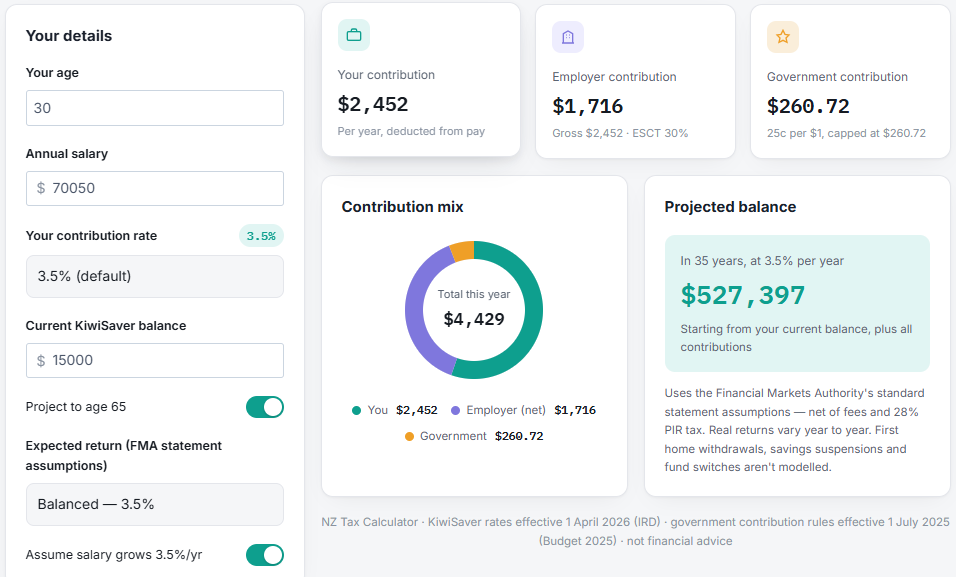
Your details
Contribution mix
Projected balance
Uses the Financial Markets Authority's standard statement assumptions — net of fees and 28% PIR tax. Real returns vary year to year. First home withdrawals, savings suspensions and fund switches aren't modelled.
Reviewed 30 July 2026 against Inland Revenue, ACC and Financial Markets Authority data.
What is KiwiSaver?
KiwiSaver is New Zealand’s voluntary, work-based retirement savings scheme, established under the KiwiSaver Act 2006. Members contribute a percentage of their before-tax salary, their employer contributes a matching amount, and the government adds a small annual top-up — all invested in a fund the member chooses, until they reach the qualifying retirement age of 65 (with limited earlier withdrawal for a first home).
Key facts
| Fact | Value |
|---|---|
| Minimum employee contribution rate | 3% (temporary reduction option) |
| Default employee contribution rate | 3.5% (from 1 April 2026) |
| Minimum employer contribution rate | 3.5% (matches the default) |
| Government contribution rate | 25 cents per dollar contributed |
| Maximum government contribution | $260.72 per year |
| Government contribution income cap | $180,000 |
| Minimum age to join | 16 (no employer/government contribution below this) |
| Qualifying retirement age | 65 |
How this Kiwisaver calculator works
Enter your age, salary and contribution rate — the calculator works out what you, your employer, and the government each add, then projects your balance to 65.
- Your contribution = salary × your chosen rate (3%–10%)
- Employer contribution = salary × 3.5% minimum, minus ESCT (the tax on it before it reaches your account)
- Government contribution = 25c per dollar you contribute, capped at $260.72/year
- Projected balance = all three, compounding yearly at your chosen return rate to age 65.
Uses IRD, ACC and FMA rates for 2026/27
Formulas used in Kiwisaver calculator nz
Ready to see how your KiwiSaver grows over time? Use our free KiwiSaver Calculator NZ to estimate your retirement savings, employer contributions, government contributions, and investment growth in seconds. Then explore the formulas below to understand exactly how each calculation works.
Your contribution
Your_contribution = salary × contribution_rate
Employer contribution (net of ESCT)
Employer_gross = salary × max(contribution_rate, 0.035)
Esct_threshold = salary + employer_gross
Esct_rate = lookup(esct_threshold) // table below
Employer_net = employer_gross × (1 − esct_rate)
Government contribution (Member Tax Credit)
Government_contribution = eligible ? min(your_contribution × 0.25, 260.72) : 0
eligible = age ≥ 16 AND salary ≤ 180000
Balance projection (year by year)
For each year until retirement:
Contribution_total = your_contribution + employer_net + Government_contribution
Balance = balance × (1 + return_rate) + contribution_total
Salary = salary × 1.035 // if salary growth is on
Current KiwiSaver Contribution Rates (2026)
| Rate type | Current rate | Changing to | Effective date |
|---|---|---|---|
| Default employee contribution | 3.5% | 4% | 1 April 2026 → 1 April 2028 |
| Default employer contribution (must generally match) | 3.5% | 4% | 1 April 2026 → 1 April 2028 |
| Optional employee rates available | 3%, 3.5%, 4%, 6%, 8%, 10% | — | Ongoing |
| Temporary rate reduction | Down to 3%, for 3–12 months | Reverts to default after 12 months | Available from 1 February 2026 |
| Government contribution | 25 cents per $1 contributed | Max $260.72/year | Since 1 July 2025 |
| Government contribution income cap | Not eligible if earning $180,000+ | — | Since 1 July 2025 |
| Employer contributions for 16–17 year olds | Mandatory if employee is a KiwiSaver member | — | From 1 April 2026 |
KiwiSaver Contribution Rate Options — Which Should You Choose?
Members can choose to contribute 3%, 3.5% (the new 2026 default), 4%, 6%, 8%, or 10% of their gross salary. There’s no single “correct” rate — it depends on your income needs now versus your retirement savings goal — but two mechanical facts matter for the decision: your employer generally must match your rate only up to the default minimum, and a higher contribution rate compounds meaningfully over decades due to investment returns on a larger base amount.
Real use case: A 30-year-old earning $75,000 who increases their contribution rate from 3.5% to 6% is contributing an extra $1,875 per year from age 30 to 65 — a decision best modelled with a calculator rather than estimated by feel, since the compounding effect over 35 years is substantially larger than the simple extra-dollars-contributed figure suggests.
What Happens If I Can’t Afford the Higher Contribution Rate?
From 1 February 2026, members can apply to Inland Revenue for a temporary contribution rate reduction, dropping back to 3% for a period of 3 to 12 months. Employers can choose (but aren’t required) to match the reduced rate for that period. After 12 months, the rate automatically reverts to the prevailing default. Members can apply for a temporary reduction as many times as needed — it isn’t a one-time option.
KiwiSaver Balance Benchmarks — How Do You Compare?
According to research commissioned by New Zealand’s Retirement Commission, the average KiwiSaver balance across all members is approximately $37,079, and for members aged 61–65 — close to accessing NZ Super — the average balance is only around $69,104. Massey University’s retirement expenditure guidelines are often used alongside these figures to estimate what a comfortable retirement lump sum actually requires, which is typically well above the current average balance for those nearing 65.
Related calculators
Discover more free New Zealand financial calculators to calculate PAYE tax, convert hourly pay to annual salary, estimate student loan repayments, and make smarter financial decisions.
Frequently Asked Questions
How much KiwiSaver should I have at 40?
There is no fixed amount you should have in your KiwiSaver at age 40. Your balance depends on your salary, contribution rate, employer contributions, investment returns and how long you have been contributing. A higher contribution rate and consistent investing can significantly increase your retirement savings. Use the KiwiSaver Calculator to estimate whether you’re on track to meet your retirement goals.
What is my KiwiSaver amount?
Your KiwiSaver amount is your current retirement savings balance, which includes your personal contributions, employer contributions, government contributions (if eligible), and investment returns, minus any fees or taxes. You can check your balance through your KiwiSaver provider or estimate your future savings using our KiwiSaver Calculator.
What is better than KiwiSaver?
KiwiSaver is the most effective long term retirement savings scheme of New Zealand because it offers employer contributions and, for eligible members, government contributions. Some people choose to invest in shares, ETFs, property or managed funds alongside KiwiSaver, there is no universal investment that is better. The best strategy depends on your financial goals, risk tolerance and retirement plans.
How much will my KiwiSaver be worth when I retire?
Your retirement balance depends on several factors like your current KiwiSaver balance, annual salary, contribution rate, employer contributions, investment performance and the number of years until retirement. Because investment returns vary over time, the easiest way to estimate your future balance is by using the KiwiSaver Calculator.
What happens to KiwiSaver if I move overseas?
If you permanently leave New Zealand you can withdraw most of your KiwiSaver savings according to the KiwiSaver Scheme rules. Different rules apply if you move to Australia, where your savings can usually be transferred to a complying Australian superannuation fund instead of being withdrawn. Government contributions may not always be included in an overseas withdrawal, depending on your circumstances.
Can I withdraw all my KiwiSaver when I retire?
Yes. Once you reach the New Zealand KiwiSaver retirement age and meet the eligibility crtera, you can withdraw all or part of your KiwiSaver savings. Some providers also offer the option to leave your funds invested and make withdrawals as needed instead of taking a full lump sum.
Why is my KiwiSaver 28%?
The 28% you may see is usually Prescribed Investor Rate (PIR) tax, not your KiwiSaver contribution rate. KiwiSaver investment earnings are taxed at your PIR, which can be 10.5%, 17.5%, or 28%, depending on your taxable income. If your PIR is set incorrectly, you may pay too much or too little tax, so it’s important to confirm it with your KiwiSaver provider.
Is the KiwiSaver Calculator accurate?
Our KiwiSaver Calculator NZ provides estimates using your salary, contribution rate, employer contributions, government contributions and projected investment returns based on current New Zealand rules. Results are estimates only and should be used for retirement planning rather than financial advice.
What happens to my KiwiSaver if I die before 65?
If you die before reaching the KiwiSaver retirement age, your KiwiSaver savings generally become part of your estate. The money can then be distributed to the beneficiaries or other people entitled to your estate under your will and New Zealand succession law.
The fact that you are under 65 does not mean your KiwiSaver savings are automatically lost. Your KiwiSaver provider will require the appropriate documentation and may require probate or letters of administration, depending on the value and circumstances of the estate.