ESCT vs PAYE in NZ: What’s the Difference?
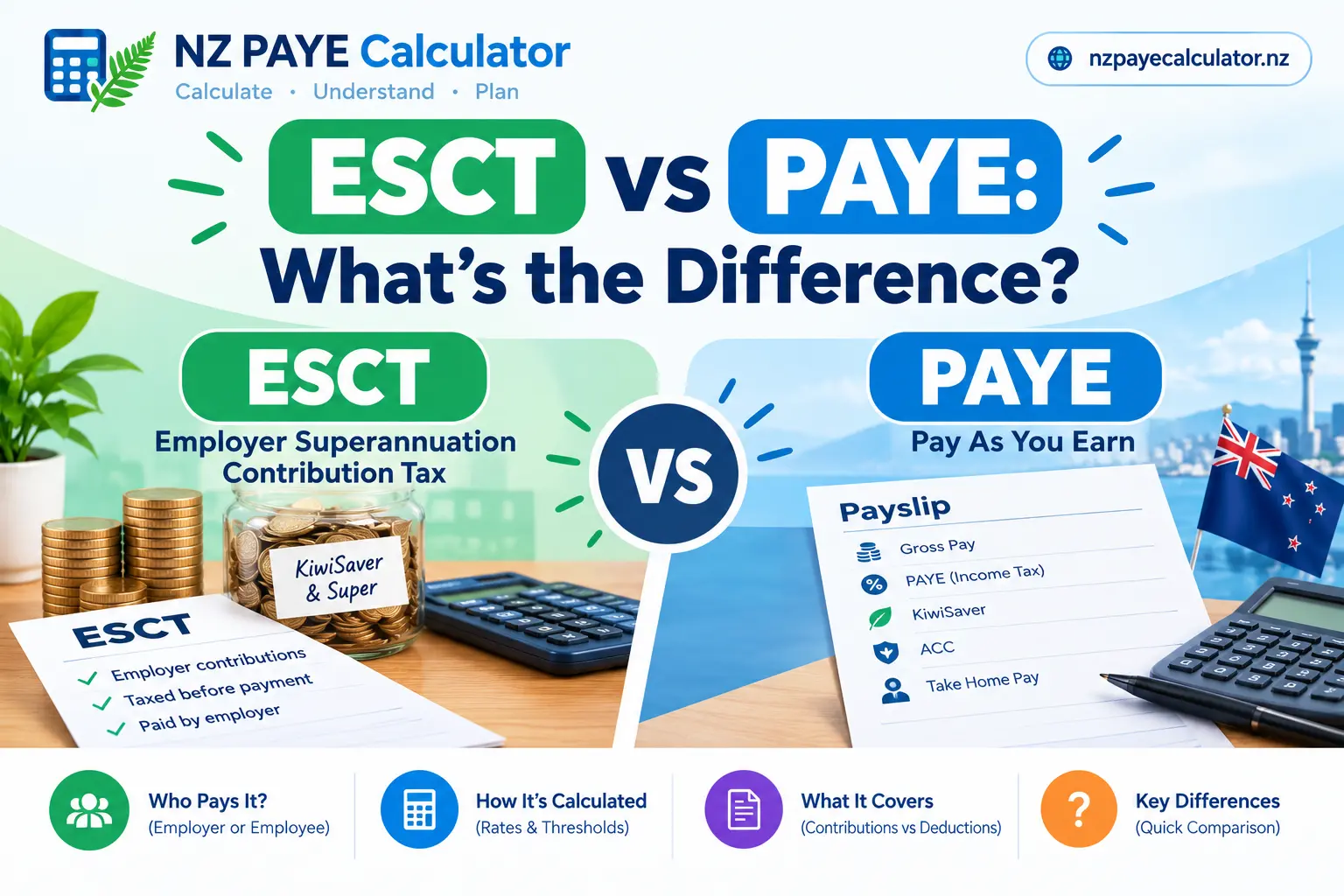
PAYE taxes your wages — deducted from your pay before it reaches you. ESCT taxes your employer’s KiwiSaver contribution — deducted from their contribution before it reaches your KiwiSaver account. They’re both deductions that happen “around” your pay, but they tax two entirely different amounts of money, use two entirely different rate tables, and neither one appears where most people expect on a payslip.
See both calculated together for your exact salary with our free PAYE Calculator and ESCT Calculator.
Table of Contents
The One-Sentence Version
If it comes out of your pay, it’s PAYE (or a related deduction like KiwiSaver or student loan). If it comes out of your employer’s contribution to your KiwiSaver, before that money ever reaches you, it’s ESCT. Confusing the two is extremely common, because both sound like generic “payroll tax” and both ultimately relate to your KiwiSaver balance — but they tax different pools of money, paid by different parties.
Side-by-Side Comparison – ESCT vs PAYE
| PAYE | ESCT | |
|---|---|---|
| Full name | Pay As You Earn | Employer Superannuation Contribution Tax |
| What it taxes | Your salary/wages | Your employer’s KiwiSaver (or complying fund) contribution |
| Who effectively pays it | You (deducted from your pay) | Your employer (deducted from their contribution, before it reaches you) |
| Rate structure | 10.5% / 17.5% / 30% / 33% / 39%, based on your annual income | 10.5% / 17.5% / 30% / 33% / 39%, based on your salary + employer super contributions, at different dollar thresholds than PAYE |
| Calculated using | Your tax code (M, ME, S, SH, etc.) | An “ESCT rate threshold amount” set annually, based on prior-year earnings |
| Visible on your payslip? | Yes, usually as a combined “PAYE” line (income tax + ACC levy) | Rarely — most employees never see it, since it’s deducted before the contribution reaches them |
| Remitted to IRD by | Employer, on your behalf | Employer, on their own behalf |
| Also covers ACC levy? | Yes, blended into the PAYE deduction table | No — ESCT is a separate, standalone calculation |
Why the Rate Tables Look Similar But Aren’t the Same
This is where genuine confusion happens — both PAYE and ESCT use the same five percentages (10.5%, 17.5%, 30%, 33%, 39%), which makes people assume they’re interchangeable. They’re not, for two reasons:
- Different thresholds. PAYE’s brackets sit at $15,600 / $53,500 / $78,100 / $180,000. ESCT’s thresholds sit at $18,720 / $64,200 / $93,720 / $216,000 — roughly 20% higher across the board, reset from 1 April 2025.
- Different income base. PAYE is based on your actual current income this year. ESCT is based on your prior year’s total earnings (salary plus employer super contributions) — a fundamentally different measurement.
Practical result: someone squarely in the 30% PAYE bracket could easily be in the 33% ESCT bracket, or vice versa, purely because the two systems measure different things over different periods.
Two Full Worked Examples, Side by Side
Here’s exactly how PAYE and ESCT apply to the same person, on the same salary, at the same time — showing how separately each deduction actually operates.
Meet Aiden: $85,000/year salary, 3.5% employer KiwiSaver contribution, no student loan.
PAYE (on Aiden’s own wages):
| Band | Calculation | Tax |
|---|---|---|
| 10.5% | $15,600 × 10.5% | $1,638.00 |
| 17.5% | $37,900 × 17.5% | $6,632.50 |
| 30% | $24,600 × 30% | $7,380.00 |
| 33% | ($85,000 − $78,100) × 33% | $2,277.00 |
| Total PAYE | $17,927.50 |
ESCT (on Aiden’s employer’s $2,975 contribution — 3.5% of $85,000):
| Aiden’s ESCT rate threshold amount (prior year salary + employer contributions) | ESCT rate applied |
|---|---|
| Falls in the $64,201–$93,720 band | 30% |
| Step | Calculation | Amount |
|---|---|---|
| Employer’s gross contribution | 3.5% × $85,000 | $2,975.00 |
| ESCT deducted | $2,975 × 30% | −$892.50 |
| Net amount reaching Aiden’s KiwiSaver from his employer | $2,082.50 |
Two completely separate calculations, two completely separate tax amounts ($17,927.50 in PAYE vs. $892.50 in ESCT), on two completely separate pools of money — Aiden’s own $85,000 salary, and his employer’s $2,975 contribution.
Where Each One Physically Shows Up
This is the part that trips people up in practice:
- PAYE appears as a clear deduction line on your payslip, directly reducing your net pay each payday.
- ESCT almost never appears on a standard employee payslip at all — it’s handled entirely on the employer’s side, deducted from their contribution before it’s even reported as going into your KiwiSaver account. You’d typically only encounter the term “ESCT” if you specifically asked your employer or accountant why the employer contribution figure looked smaller than a simple percentage calculation would suggest.
(For the full breakdown of every payslip line, see our How to Read Your NZ Payslip guide.)
Do PAYE and ESCT Ever Interact With Each Other?
Not directly — they’re calculated completely independently, and one doesn’t feed into the other. However, they’re related in one meaningful way: your PAYE tax code and your income level both influence how much money moves through the system in the first place, and your prior year’s combined salary and employer contributions (which PAYE partly determines, since it’s based on your salary) is exactly what sets your ESCT rate threshold amount for the following year.
In other words: a pay rise this year doesn’t just affect this year’s PAYE — it likely bumps your ESCT rate next year too, since ESCT looks backward at what you actually earned.
A Common Myth: “ESCT Is Just Extra PAYE on My KiwiSaver”
This is inaccurate in an important way. Your own KiwiSaver contribution (deducted from your wages) is never subject to ESCT — it’s simply part of your normal PAYE-taxed salary that you’re choosing to direct into KiwiSaver. ESCT applies exclusively to the employer’s side of the contribution. If someone tells you “ESCT is being deducted from your KiwiSaver contribution,” that’s incorrect — it’s deducted only from what your employer adds, never from what you personally contribute.
Frequently Asked Questions
What is the main difference between ESCT and PAYE?
PAYE taxes an employee’s own wages, deducted from their pay. ESCT taxes the employer’s KiwiSaver contribution, deducted from that contribution before it reaches the employee’s account — two different deductions on two different amounts of money.
Are ESCT and PAYE rates the same?
They use the same five percentages (10.5% to 39%), but at different dollar thresholds and based on different income measurements — PAYE uses current-year personal income, while ESCT uses prior-year salary plus employer super contributions.
Does ESCT reduce my take-home pay?
No. ESCT is deducted from the employer’s own KiwiSaver contribution before it reaches the employee, not from the employee’s wages, so it has no direct effect on take-home pay.
Why doesn’t ESCT show up on my payslip like PAYE does?
Because it’s handled entirely on the employer’s side of the transaction — deducted from their contribution before it’s paid into the employee’s KiwiSaver account, rather than being deducted from the employee’s own earnings.
Does my own KiwiSaver contribution get taxed by ESCT?
No, ESCT only applies to the employer’s contribution. An employee’s own KiwiSaver contribution is simply part of their PAYE-taxed salary, directed into KiwiSaver by choice.
Can a pay rise affect my ESCT rate?
Yes, indirectly. A pay rise increases your total earnings, which is used to set your ESCT rate threshold amount for the following tax year — meaning this year’s raise can push next year’s ESCT rate higher.
How can I calculate PAYE?
You can calculate PAYE in New Zealand by starting with your gross income and applying the applicable income tax rates for the tax year. You may also need to account for the ACC earners’ levy, KiwiSaver contributions, student loan repayments, and other deductions that apply to your situation.
The easiest way to estimate your PAYE and take-home pay is to use an online NZ PAYE calculator. Enter your salary or wage, choose the relevant pay frequency, and the calculator can estimate your PAYE deductions and net pay.
For an accurate result, make sure you use the tax rates and ACC earners’ levy applicable to the relevant New Zealand tax year.
This guide provides general information only, not tax advice. Employers calculating exact ESCT rates for specific employees should confirm with Inland Revenue or a payroll specialist.