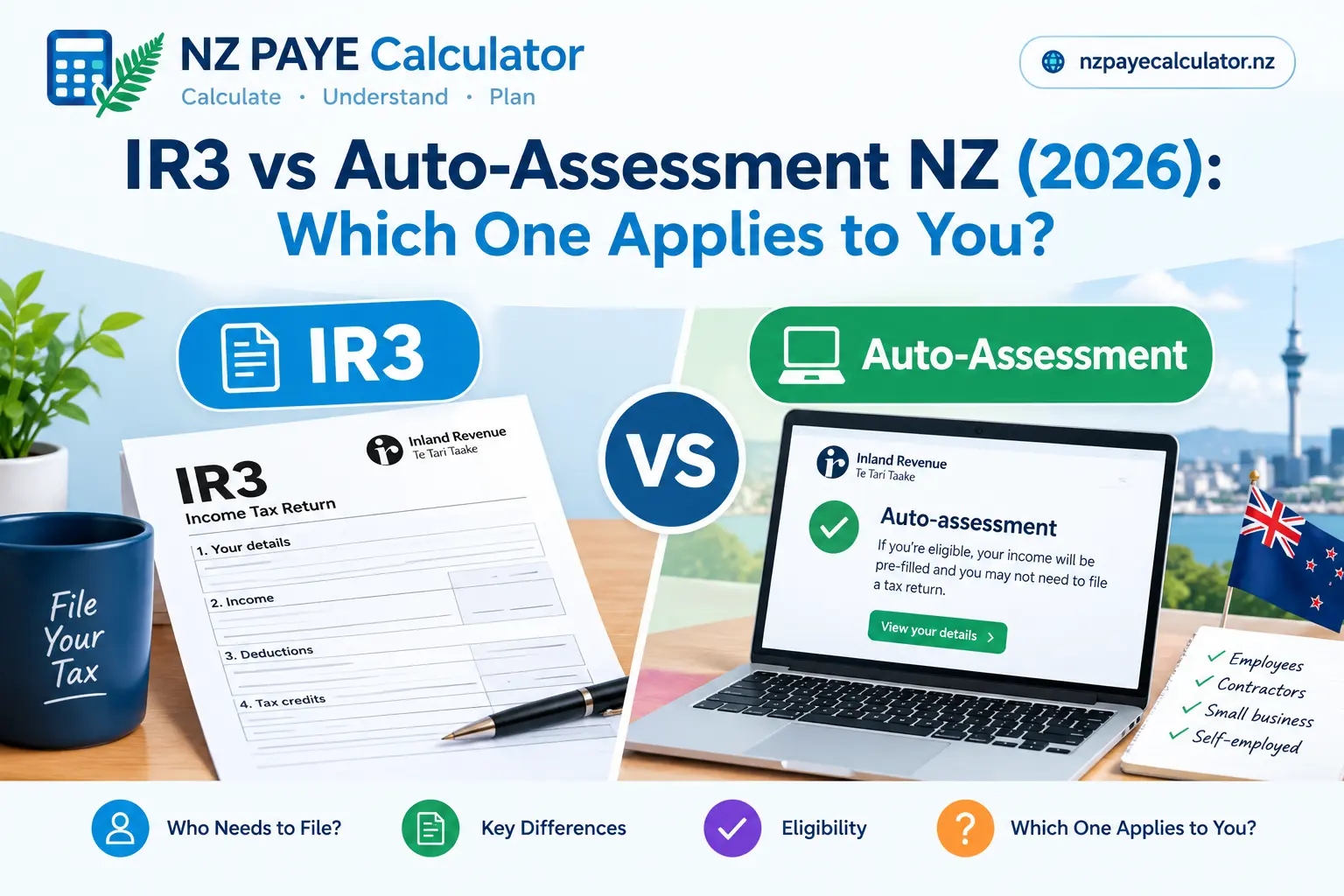
IR3 vs Auto-Assessment in New Zealand: Which One Applies to You?
If all your income for the year came from salary, wages, bank interest or NZ share dividends then income Inland Revenue (IRD) already has on file — you will get an automatic income tax assessment and won’t need to file anything. If you earned income IRD doesn’t already know about (self-employment, rental income, most overseas income, or a bright-line property sale), you need to file an IR3 individual income tax return yourself, even if IRD also sends you an automatic assessment.
Auto-assessment only works when every dollar you earned is already sitting in IRD’s system. The moment one dollar falls outside that net, the IR3 becomes compulsory — regardless of what the automatic assessment shows.
Table of Contents
What Is an Automatic Income Tax Assessment?
Since April 2019, IRD has run an automatic end-of-year process for most salary and wage earners. Between late May and July each year, IRD compares the tax you paid through PAYE against your actual tax liability, using data it already receives from employers, banks, and share registries — no return required.
If the numbers match, nothing happens. If you paid too much, you get a refund. If you paid too little, you get a bill.
What auto-assessment typically covers:
- PAYE salary and wages
- Bank interest (Resident Withholding Tax already deducted)
- Fully imputed NZ share dividends
- Working for Families adjustments already reported
You can view and confirm your assessment directly in myIR — IRD’s online account portal. If you don’t take any action, most assessments auto-confirm after the deadline shown.
What Is an IR3 Individual Income Tax Return?
An IR3 is a return you file yourself, reporting income that IRD hasn’t already been told about. According to IRD, you generally need to file one if you received more than $200 (before tax) in untaxed income during the year, even if that was for only part of the year.
You’ll usually need to file an IR3 if you had any of the following:
| Income or situation | Why an IR3 is required |
|---|---|
| Self-employment or contracting income | Not automatically reported to IRD in full |
| Rental income from an investment property | Requires you to declare income and claim expenses |
| Overseas income (employment, investments, business) | Often untaxed at source in NZ |
| A bright-line property sale | Needs to be separately calculated and declared |
| Schedular payments taxed at a lower elected rate (IR330C) | Triggers year-end reconciliation |
| Income from a trust, partnership, or look-through company | Not part of the standard PAYE/RWT data feed |
| Shareholder-employee income | Falls outside standard payroll reporting |
| You want to claim deductions or credits not already applied (e.g. donations, missed IETC) | Auto-assessment won’t pick these up on its own |
If you’re not a New Zealand tax resident, note that you’d file an IR3NR instead of a standard IR3.
IR3 vs Auto-Assessment: Side-by-Side Comparison
| Automatic Assessment | IR3 Return | |
|---|---|---|
| Who it’s for | PAYE earners with only “known” income (wages, bank interest, imputed dividends) | Anyone with untaxed or additional income sources |
| Who initiates it | IRD, automatically | You, via myIR or a tax agent |
| When it happens | Late May – July, after the 31 March year-end | Due by 7 July if self-filed |
| Extension available? | No — it’s automatic | Yes, until 31 March the following year, if filed through a tax agent with an extension of time |
| Action required from you | Review and confirm (or do nothing — it auto-confirms) | Actively complete and submit the return |
| Covers rental, self-employment, or overseas income? | No | Yes |
| Can you claim missed deductions? | Not automatically | Yes — this is one of the main reasons people file an IR3 voluntarily |
| Penalty for skipping it when required | Not applicable | Late filing penalties from $50, plus use-of-money interest on unpaid tax |
Worked Examples: Which One Applies?
Real scenarios make this far clearer than definitions alone.
Example 1 — Straightforward PAYE earner (auto-assessment applies) Aroha earns $72,000 a year from one employer, has no other income, and hasn’t changed jobs mid-year. IRD already holds her full PAYE record. She receives an automatic assessment in June — no IR3 needed. If it shows a refund, it’s paid directly to her bank account once confirmed.
Example 2 — Rental property owner (IR3 required) Lisa is a teacher earning $72,000 PAYE and also owns a rental property earning $24,000 a year, with $18,000 in deductible expenses (mortgage interest, rates, insurance, and property management fees). Because her employer only withheld PAYE on her salary, she owes additional tax on the net rental income at year end and must file an IR3 to declare it — an automatic assessment alone would understate her true tax position.
Example 3 — Freelancer on a lowered withholding rate (IR3 required) Maia is a freelance designer who elected a lower withholding rate on her schedular payments using an IR330C. Because tax wasn’t withheld at the standard rate, IRD requires year-end reconciliation through an IR3 to settle the difference.
Example 4 — PAYE earner with overseas dividends (IR3 recommended) Ben earns $60,000 in salary and also receives NZ dividends with imputation credits attached, plus a small amount of foreign dividend income. The foreign portion isn’t part of the standard auto-assessment data feed, so filing an IR3 is the cleanest way to make sure the full picture — and any refund he’s owed — is captured correctly.
Key Dates You Need to Know
| Deadline | Applies to |
|---|---|
| 31 March | End of the NZ tax year |
| Late May – July | IRD issues automatic assessments |
| 7 July | IR3 filing deadline if you file it yourself |
| 31 March (following year) | Extended IR3 deadline if filed through a tax agent with an extension of time |
| 7 February | Terminal tax (tax owing) due date without a tax agent extension |
| 7 April | Terminal tax due date with a tax agent extension |
Dates reflect the current IRD schedule and may be adjusted slightly year to year — always confirm the exact dates for the relevant tax year in myIR or with your tax agent.
How to Check Which One Applies to You
- Log into myIR after 31 March and check whether IRD has already issued you an automatic assessment.
- Review it carefully. If it matches your full income picture, you can confirm it (or let it auto-confirm).
- Ask yourself: did I earn anything IRD wouldn’t already know about? Self-employment, rental, overseas income, or a property sale means you need to file an IR3 — even if an automatic assessment has already appeared.
- If in doubt, run the numbers first. Our Tax Return Calculator NZ lets you estimate whether you’re likely to owe tax or receive a refund before IRD’s assessment lands, so you’re not caught off guard either way.
- If you’re an employer working out KiwiSaver costs at the same time, our ESCT Calculator NZ is a related tool worth bookmarking — Employer Superannuation Contribution Tax is a separate calculation from personal income tax but often comes up in the same year-end conversations for small business owners paying themselves through payroll.
If you’re still deciding, estimate any refund first with our tax return calculator. If a second income is involved, read how second job tax works, check you’re on the right NZ tax code, and see the current PAYE tax brackets.
Frequently Asked Questions
Do I need to file a tax return if IRD already sent me an assessment?
Not usually — if the assessment is correct and covers all your income, you don’t need to do anything further. You only need to file an IR3 instead of (or in addition to) accepting the assessment if you had income the assessment doesn’t cover.
What happens if I don’t file an IR3 when I should have?
IRD can charge late filing penalties starting at $50, plus use-of-money interest on any tax owing. It’s better to file late than not at all, and if you can’t pay on time, contact IRD before the due date to arrange a payment plan.
Can I get a refund through an IR3 the same way as an auto-assessment?
Yes. If your IR3 shows you overpaid tax, IRD pays the refund to the bank account it holds for you in myIR, generally within one to two weeks of the return being processed.
I have a small amount of untaxed income — do I still need to file?
Generally yes, if it’s more than $200 (before tax) for the year. Below that threshold, it typically doesn’t trigger a filing requirement on its own, but it’s worth checking your full picture in myIR.
Does having a student loan or KiwiSaver change whether I need an IR3?
Not directly — student loan repayments and KiwiSaver contributions are handled through PAYE either way. What determines the IR3 requirement is the source of your income, not these deductions.
What does IR3 stand for?
IR3 stands for “Individual income tax return” in New Zealand. It is the tax return used by individuals to report their income and claim eligible expenses to Inland Revenue (IRD). An IR3 can also determine whether you have tax to pay or a tax refund for the tax year.
What is an IR3 form in NZ?
An IR3 form is New Zealand’s Individual income tax return for individuals who need to report income to Inland Revenue. You may need to file an IR3 if you received income that was not taxed before you received it, such as self-employment income, rental income, overseas income, or certain investment and other income.
Most people whose only income is salary or wages with the correct PAYE deductions generally do not need to file an IR3 themselves because Inland Revenue can usually issue an income tax assessment automatically.
You can complete an IR3 through myIR, where some income information may already be included. Inland Revenue says the normal filing deadline is 7 July, unless you have a tax agent or an approved extension of time.
What is the difference between IR3 and IR3NR?
IR3 is the Individual income tax return generally used by New Zealand residents, while IR3NR is the Individual income tax return for non-resident taxpayers. The correct form depends on your tax-residency situation and income.
Who needs to file an IR3 in New Zealand?
You may need to file an IR3 if you received more than $200 of income before tax that Inland Revenue was not told about, or if other circumstances require an individual tax return. Examples include certain self-employment, rental, overseas, shareholder, trust or untaxed income.
If you were a non-resident for the full tax year, a different return called IR3NR may apply.
Sources
- Inland Revenue — Individual income tax return (IR3)
- Inland Revenue — Work out tax on your yearly income
- New Zealand Government — End-of-year income tax assessments
This article is general information based on current IRD rules and is not personalised tax advice. Figures and deadlines should be confirmed against IRD’s current guidance, as thresholds and dates can change from year to year.