
NZ Tax Codes Explained: M, ME, S, SH, ST, SB & SL
New Zealand has 17 distinct tax codes across the IR330 and IR330C forms: four main-income codes (M, ME, M SL, ME SL), five secondary codes (SB, S, SH, ST, SA, each with an SL variant), and several special purpose codes (WT, CAE, EDW, NSW, STC) for contractors, casual agricultural work, election work, seasonal work visas and custom IRD approved rates.
Not sure which applies to you? Check your numbers with our free PAYE Calculator.
Table of Contents
M — Main Income, Standard
M is the default Nz tax code for your main or highest-earning source of income when none of the special circumstances below apply. Per the IR330, you must also use M (or M SL) not ME — if you or your partner receive Working for Families Tax Credits, a main benefit, NZ Superannuation, a Veteran’s Pension, or an overseas equivalent of any of these, regardless of your income level. This is a commonly missed rule: even someone earning well within the IETC income band cannot use ME if they or their partner receive one of these payments.
Example: Grace earns $58,000 at her only job. Neither she nor her partner receives Working for Families or a benefit. She could technically use ME — but if her partner starts receiving Working for Families mid-year, she must switch back to M immediately, even though her own income and job haven’t changed at all.
ME — Main Income With Independent Earner Tax Credit
ME delivers the Independent Earner Tax Credit (IETC) — worth up to $520/year — through your regular pay, rather than requiring you to claim it separately at year-end. Eligibility requires all of the following:
- Annual income between $24,000 and $70,000
- You (and your partner, if applicable) do not receive Working for Families, a main benefit, NZ Super, a Veteran’s Pension or an overseas equivalent
- This is your main source of income
The credit abates (reduces) between $66,000 and $70,000, reaching zero at $70,000 — so someone at $68,000 receives a partial credit, not the full $520.
Example: Hemi earns $45,000 at his only job, receives no government support, and isn’t part of a couple receiving Working for Families. He uses tax code ME, receiving roughly $10/week extra in his pay through the credit rather than needing to claim it via IRD at year-end.
Secondary Codes (SB, S, SH, ST, SA) — Based on Combined Income
These apply to any job that isn’t your main income source. The defining rule, worth repeating because it’s the most common error: the code is chosen based on your total expected income across all jobs combined, not the secondary job’s income in isolation.
| Tax Code | Combined income band | Flat rate |
|---|---|---|
| SB | $0 – $15,600 | 10.5% |
| S | $15,601 – $53,500 | 17.5% |
| SH | $53,501 – $78,100 | 30% |
| ST | $78,101 – $180,000 | 33% |
| SA | $180,001+ | 39% |
Example — a three-job scenario: Michael has a main job ($40,000), a weekend job ($8,000), and a casual gig-economy job ($6,000) — a combined total of $54,000. Both secondary jobs are assessed against this same combined figure, placing them in the SH band (30%), even though each individual secondary job pays far less than $53,501 on its own.
SL — The Student Loan Suffix (Not a Standalone Code)
SL attaches to any base code — M SL, ME SL, SB SL, S SL, SH SL, ST SL, SA SL — adding a 12% deduction on income above the $24,128/year repayment threshold, on top of whatever income tax the base code already calculates. See our dedicated SL vs M SL Tax Code guide for the complete mechanics and a worked multi-job example.
WT — Withholding Tax for Contractors (Schedular Payments)
WT is fundamentally different from every code above as it’s not for salary or wages at all, but for contractors receiving schedular payments (a defined list of activities under Schedule 4 of the Income Tax Act 2007, including agricultural contracting, cleaning, entertainment work, and more). Contractors declare their chosen rate on a separate form, the IR330C — never the IR330, which is exclusively for employees.
Rate range: generally 10%–40%, with some activity-specific minimums, or 45% if no IR330C is provided at all — even higher than the employee no-notification rate in relative terms, since contractors have no tax-free bottom bracket built in the way employees do.
(Full mechanics, including the critical GST-exclusive calculation rule: see our GST for Contractors NZ guide.)
CAE — Casual Agricultural Employee
Per IRD’s own criteria, CAE applies specifically to people doing casual, day-to-day seasonal agricultural work for up to 3 months, who earn no other income during that time — the official examples given are shearers and shearing shed-hands. The rate is a flat 17.5% (excluding the ACC earner’s levy, which is calculated and added separately).
Important boundary: if a shearer also holds other income during the same period — even a small amount — CAE may no longer be the correct code, since the “no other income” condition is part of the eligibility test, not just a description of the typical situation.
Example: Wiremu works a 6-week shearing run over summer, earning $9,000, with no other income during that period. His employer uses CAE, applying a flat 17.5% regardless of the total amount earned across the 6 weeks.
EDW — Election Day Worker
EDW covers only temporary work during a general election — specifically the advance voting period plus election day itself (commonly around a 2-week window). Like CAE, it’s a flat 17.5% rate (excluding ACC). This is a genuinely narrow, short-lived code — most New Zealanders will only ever encounter it if they specifically work as a polling place staff member during an election period.
Example: Aroha works as an advance voting booth assistant for 10 days during a general election, earning $1,800 total. Her code for this specific income is EDW, taxed flat at 17.5%.
NSW — Non-Resident Seasonal Worker
NSW applies to Recognised Seasonal Employer (RSE) scheme workers, and separately to people holding a work visa as foreign crew on a vessel fishing New Zealand waters. The rate is a flat 10.5% (excluding ACC) — the lowest of the special flat-rate codes, reflecting the typically lower, defined-term nature of this seasonal work.
Example: Sione arrives in New Zealand under the RSE scheme for a 6-month contract picking fruit in Hawke’s Bay. His employer uses NSW, applying a flat 10.5% rate to his earnings for the duration of his RSE visa.
STC — Special Tax Code
Full detail: An STC is a custom withholding rate, individually calculated by IRD to suit a specific person’s circumstances — used when none of the standard codes produce a fair result (for example, someone with significant deductible expenses, or unusual income patterns across a tax year). To use it, you need a current special tax code certificate from IRD, which you provide to your employer alongside your IR330. Unlike the standard codes, an STC generally needs to be applied for and renewed, rather than self-selected from a list.
Example: Priya has substantial rental property losses that regularly reduce her real tax liability well below what her standard M code would withhold. Rather than overpaying all year and waiting for a refund, she applies to IRD for an STC, receives a certificate specifying a lower withholding rate, and gives it to her employer.
The 183-Day Residency Test — Relevant Across Several Codes
Several of these codes interact with New Zealand’s tax residency rules. Per the IR330, you’re generally treated as NZ tax resident if any of the following apply:
- You’ve been in New Zealand for more than 183 days in any 12-month period, and haven’t become a non-resident
- You have a permanent place of abode in New Zealand
- You’re away from New Zealand in the service of the New Zealand Government
This matters directly for NSW and WT specifically, since non-resident status is part of what defines eligibility for those codes — someone who has actually become NZ tax resident partway through a seasonal contract may need to switch away from NSW.
One Code Per Income Source — A Rule Worth Repeating
The IR330 explicitly requires a separate tax code declaration for each source of income, and only one code per source — you cannot blend two codes for a single job, and each employer needs their own completed form from you, even if you’re already declared to a different employer. This is why someone with three jobs completes three separate IR330 forms, potentially with three different codes, not one form covering everything.
Frequently Asked Questions
How many tax codes are there in New Zealand?
Around 17 distinct codes across the IR330 and IR330C forms, covering main income (M, ME, plus SL variants), secondary income (SB, S, SH, ST, SA, plus SL variants), and special situations (WT, CAE, EDW, NSW, STC).
What is the CAE tax code and who uses it?
CAE is for casual agricultural employees doing day-to-day seasonal work for up to 3 months with no other income during that period, such as shearers and shearing shed-hands. It’s taxed at a flat 17.5%, excluding ACC.
What is the EDW tax code?
EDW applies to temporary election workers during the advance voting period and election day itself, taxed at a flat 17.5%, excluding ACC.
Who uses the NSW tax code?
Recognised Seasonal Employer (RSE) scheme workers, and people holding a work visa as foreign crew on a fishing vessel in New Zealand waters, taxed at a flat 10.5%, excluding ACC.
What is a special tax code (STC) and how do I get one?
An STC is a custom withholding rate calculated by Inland Revenue for a specific person’s circumstances, used when standard codes wouldn’t produce a fair result. It requires applying to IRD for a special tax code certificate, which is then given to the employer alongside the IR330.
Can I use two tax codes for one job?
No. Only one tax code applies per source of income, and a separate IR330 declaration is required for each different source of income you have.
Does the 183-day rule affect my tax code?
It can, particularly for non-resident-specific codes like NSW. If someone becomes a NZ tax resident partway through a seasonal work arrangement, their correct tax code may need to change.
Where do I find my NZ tax code?
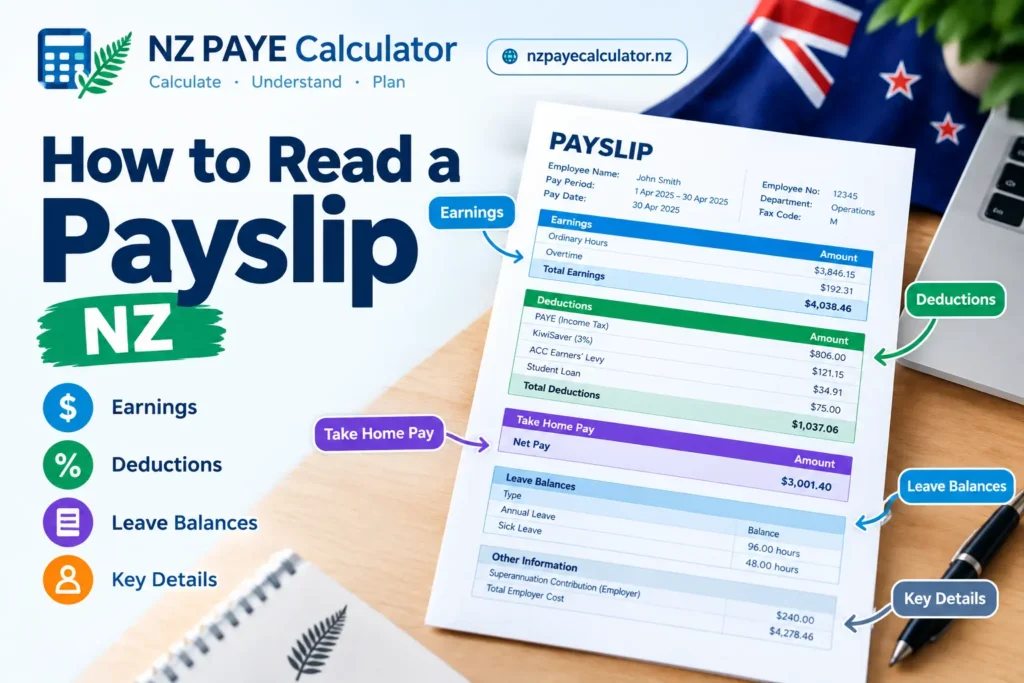
You can usually find your NZ tax code on your payslip or employment and payroll records. If you have just started a job, your employer will ask you to complete a Tax code declaration (IR330), which tells them which tax code to use for your wages.
If you are unsure which tax code applies to you, Inland Revenue provides a tax-code tool and the IR330 tax-code declaration to help you choose the correct code.
Your tax code can depend on whether the income is your main or secondary income, your income level, and whether you have a New Zealand student loan.
What is the purpose of a tax code in New Zealand?
The purpose of a tax code is to tell your employer or other income payer how much PAYE tax to deduct from your income.
The correct tax code helps ensure that the appropriate amount of tax is deducted from your salary or wages during the year. Using the wrong code can result in paying too much or too little tax and may lead to a refund or tax bill at the end of the tax year.
For example, M is commonly used for a main source of income, while M SL can apply when the main income is subject to New Zealand student-loan deductions. Secondary income can use codes such as SB, S, SH, ST or SA, depending on the circumstances.
How can I update my tax code in New Zealand?
If your circumstances change, you should check whether you need to change your tax code. Changes that may affect your tax code include starting a second job, changing your expected income, taking out a student loan, or paying off a student loan.
For salary or wages, complete a new IR330 Tax code declaration and give it to your employer. If you receive a benefit, NZ Superannuation, Veteran’s Pension or student allowance, you generally give the completed form to Work and Income instead.
You are responsible for telling your employer or payer when your tax code changes.
What is the highest tax code in New Zealand?
There is no single “highest tax code” because NZ tax codes identify different income and taxpayer circumstances rather than simply representing a tax rate.
If you mean the highest individual income-tax rate, the current top rate is 39% on income over $180,000. For secondary income, the corresponding highest secondary tax code is SA, which applies where estimated annual total income is $180,001 or more.
It is therefore important to distinguish between a tax code (such as M, M SL, S or SA) and a tax rate (such as 39%).
How can I change my tax code if I have more than one job?
If you have more than one source of taxable income, you may need a secondary tax code for your additional income. The correct code depends on your estimated total annual income and circumstances.
When you start a new source of income, tell the payer which tax code applies and provide a completed IR330 where required. This helps the payer deduct PAYE at the appropriate rate.