Teacher Salary NZ: Complete Guide
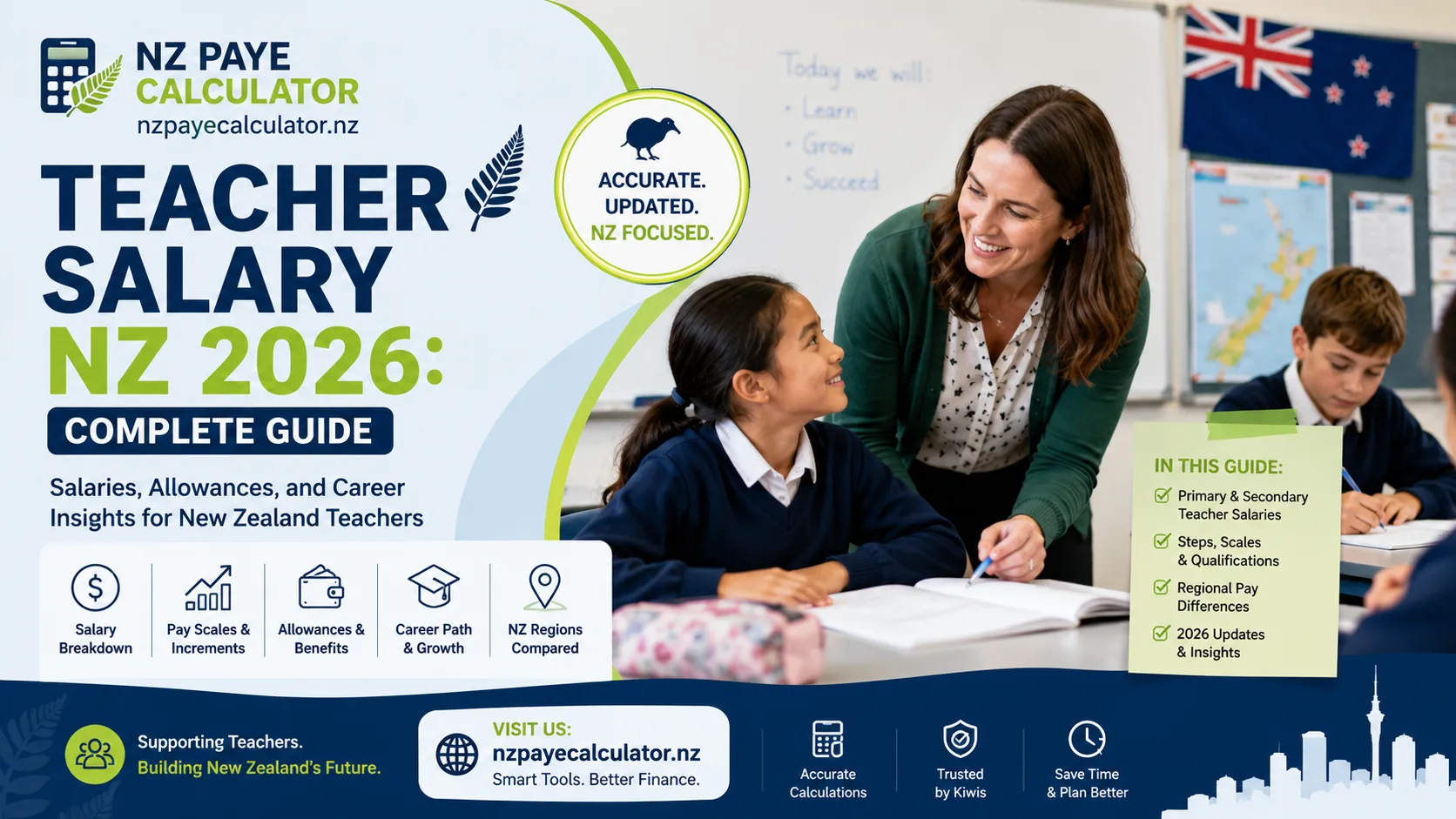
Teacher Salary NZ 2026: Full Pay Scales & Visa Guide
New Zealand teacher salary is set nationally by collective agreement, not negotiated per-school. Under the 2026 PTCA and STCA settlements, the top step of the pay scale reached $105,686 from 28 January 2026, rising to $107,886 from 28 January 2027 — for both primary and secondary teachers. Registered primary, intermediate, and secondary teachers sit on the Green List Tier 1 (Straight to Residence), not Tier 2.
See your actual take-home pay on any step of the scale using our free PAYE Calculator.
Table of Contents
What is salary?
A salary is a fixed amount of pay an employee receives regularly — usually weekly, fortnightly, or monthly — agreed as an annual total rather than calculated by the hour. Unlike an hourly wage, a salaried employee is typically paid the same amount each pay period regardless of the exact hours worked in that period, though most salaried roles still have expected standard hours (e.g., 40 hours/week) set out in the employment agreement.
Key characteristics of a salary:
- Fixed and predictable — the same gross amount each pay period, unlike hourly pay which varies with hours worked
- Quoted as an annual figure (e.g., “$70,000/year”), even though it’s paid out weekly, fortnightly, or monthly
- Before tax (gross) unless stated otherwise — actual take-home pay is lower once income tax, ACC levy, KiwiSaver, and any student loan deductions are applied
Primary Teacher Salary Scale (PTCA, 2026)
Primary teacher salary follows the Primary Teachers’ Collective Agreement (PTCA), negotiated between NZEI Te Riu Roa and the Ministry of Education. Following the 2026 settlement (ratified 2 April 2026), teachers on the top two steps of the scale received a cumulative 4.7% increase by January 2027 — a 2.5% rise effective immediately, plus a further 2.1% from 28 January 2027.
| Milestone | Salary |
|---|---|
| Top of scale, from settlement date (2 April 2026) | Base increased 2.5% |
| Top of scale, from 28 January 2027 | $107,886/year |
| Annual service-based progression (steps below top) | Advances one step per year of service, per PTCA schedule |
(Source: Beehive.govt.nz — Primary Teachers’ vote to accept pay settlement; Ministry of Education — Collective Agreement negotiations.)
Secondary Teacher Salary Scale (STCA, 2026
Secondary teacher pay follows the separate Secondary Teachers’ Collective Agreement (STCA), negotiated with the Post Primary Teachers’ Association Te Wehengarua (PPTA), ratified 4 December 2025 for the 2025–2027 term.
| Detail | Figure |
|---|---|
| Trained scale step 10 (top step), from 28 January 2026 | $105,686/year (~$2,432 gross/fortnight) |
| Trained scale step 10, from 28 January 2027 | $107,886/year (~$2,483 gross/fortnight) |
| Average starting salary (most recent official figure, 2024) | $78,300/year |
| Annual service-based progression (below top step) | $2,503–$6,960/year, equivalent to 3.9%–7.7% |
| Base pay rise, all teachers not on top steps | 2.5% (28 January 2026) + a further 2.0% within 12 months |
(Source: Ministry of Education — Secondary Teachers’ Collective Agreement negotiation; PPTA — Part 4: Remuneration, STCA.)
Notable detail most guides miss: primary and secondary top-step pay converge at exactly $107,886 by January 2027 — the two collective agreements are negotiated separately, but pay parity at the top of the scale is a deliberate, stated outcome of both 2025–2027 settlements.
How the Collective Agreement Pay-Step System Actually Works
Unlike most professions, NZ teacher salaries aren’t negotiated between an individual teacher and their school. Both the PTCA and STCA set a national step scale — a registered teacher advances one step per year of qualifying service, moving toward the top step regardless of which state school they work at. This is why teacher pay is remarkably consistent across the country, whether in central Auckland or a small rural town — the scale, not the location, sets the number.
What can shift your position on the scale:
- Prior teaching service, including some recognised overseas experience — confirm in writing with your employer before accepting a role
- Additional responsibility allowances — Deputy Principal, Assistant Principal, and management units add meaningfully on top of base step pay
- Specific new allowances from the 2026 settlements — for example, the STCA introduced a Principal’s Nominee allowance of $2,500/year from 26 April 2026, and increased middle/senior management allowance base rates to $2,400 from 28 January 2026
What Does This Actually Look Like After Tax?
A headline salary figure isn’t what lands in your bank account — New Zealand income tax, the ACC earner’s levy, and (if applicable) KiwiSaver all come out first. This is the single most useful number most teacher-salary content skips entirely, and it’s exactly what our PAYE Calculator is built to show instantly for any salary figure.
Worked example — a secondary teacher on the $78,300 average starting salary:
| Step | Calculation | Amount |
|---|---|---|
| 10.5% band | $15,600 × 10.5% | $1,638.00 |
| 17.5% band | $37,900 × 17.5% | $6,632.50 |
| 30% band | ($78,300 − $53,500) × 30% | $7,440.00 |
| Total PAYE income tax | $15,710.50 | |
| ACC earner’s levy (1.75%) | $78,300 × 1.75% | $1,370.25 |
| Take-home pay (before KiwiSaver) | ~$61,219/year, or roughly $2,354/fortnight |
Run the exact numbers for any step of the scale, including KiwiSaver contributions, using our free PAYE Calculator — genuinely useful before comparing a job offer against your current cost of living.
Also Read: GST for Sole Traders & Self Employed in NZ
Is Teaching on the Green List? Getting This Right Matters
Yes — and specifically, registered primary, intermediate, and secondary school teachers moved to Green List Tier 1 (Straight to Residence) on 26 March 2025. This is a meaningfully better pathway than Tier 2: Tier 1 lets a qualifying teacher apply for residence directly, without first completing a 24-month qualifying work period in New Zealand.
Early Childhood Education (ECE) teachers remain on Tier 2 (Work to Residence) specifically, requiring 24 months of continuous, qualifying NZ work experience (only counted from 29 September 2021 onward) before a Resident Visa application — a genuinely different pathway from primary/secondary teachers, and a distinction some other guides blur.
| Teacher type | Green List tier | Pathway |
|---|---|---|
| Primary school teacher | Tier 1 (since 26 March 2025) | Straight to Residence — no NZ work period required first |
| Intermediate school teacher | Tier 1 (since 26 March 2025) | Straight to Residence |
| Secondary school teacher | Tier 1 | Straight to Residence |
| Early Childhood Education (ECE) teacher | Tier 2 | Work to Residence — 24 months qualifying NZ work required first |
(Source: Immigration New Zealand — Green List.)
The Pay Threshold Just Changed — Step 5, Not Step 4
This is a genuinely fresh detail worth knowing if you’re planning an application: from 9 March 2026, Immigration New Zealand’s general median wage threshold rose to $35.00/hour (up from $33.56). Because teacher pay steps are assessed against this threshold for Tier 1 eligibility, qualifying teachers must now be on Step 5 of the pay scale, not Step 4 as previously required — a real, dateable eligibility shift that hasn’t fully propagated through older published guides.
In dollar terms, Step 5 corresponds to roughly $78,000–$80,000/year — meaning a newly arrived teacher starting at the bottom of the scale won’t immediately qualify for Tier 1 residence; reaching Step 5 typically takes a small number of years of service, an important planning detail for anyone timing a move around residency eligibility.
What Overseas Teachers Need — Teaching Council Registration
No one can teach independently in a New Zealand school — state or private — without registration from the Teaching Council of Aotearoa New Zealand.
The process for overseas-qualified teachers:
- Create an account on the Teaching Council’s online portal
- Submit qualifications for assessment: official transcripts, confirmation of your home-country teaching licence, a police clearance certificate from every country lived in for 12+ months, and English language evidence if required
- Assessment typically takes 3–6 months for overseas applicants
- Provisional (or provisional with conditions) registration is often granted first, allowing supervised teaching under a mentor
- Full registration follows once all conditions are met
Qualification recognition varies by country of origin and is assessed case by case — confirm your specific qualification’s status directly with the Teaching Council before beginning the formal process.
Frequently Asked Questions
What is the top teacher salary in New Zealand in 2026?
$105,686/year from 28 January 2026, rising to $107,886/year from 28 January 2027 — the same top-step figure for both primary (PTCA) and secondary (STCA) teachers under their respective 2025–2027 collective agreement settlements.
Is teaching on the NZ Green List Tier 1 or Tier 2?
Primary, intermediate, and secondary school teachers are on Tier 1 (Straight to Residence), as of 26 March 2025 — not Tier 2. Early Childhood Education teachers remain on Tier 2 (Work to Residence), requiring 24 months of qualifying NZ work first.
What pay step do I need to reach for Green List Tier 1 residence?
Step 5 of the pay scale, following the 9 March 2026 median wage threshold increase to $35.00/hour — up from the previous Step 4 requirement.
What is the average secondary teacher starting salary in NZ?
$78,300/year, based on the most recent officially reported figure (2024), from the Ministry of Education.
How long does Teaching Council registration take for overseas teachers?
Typically 3–6 months for assessment, with provisional registration sometimes granted first, allowing supervised teaching while full registration conditions are completed.
Do teachers earn more in Auckland than other parts of NZ?
No, not meaningfully — because pay follows a single national collective agreement scale (PTCA or STCA), base salary is essentially the same regardless of region; only cost of living differs by location.
What’s my actual take-home pay as a teacher in NZ?
It depends on your exact step and any KiwiSaver contribution, but is meaningfully lower than the headline salary once PAYE income tax and the ACC earner’s levy are deducted — use our PAYE Calculator for your precise figure.