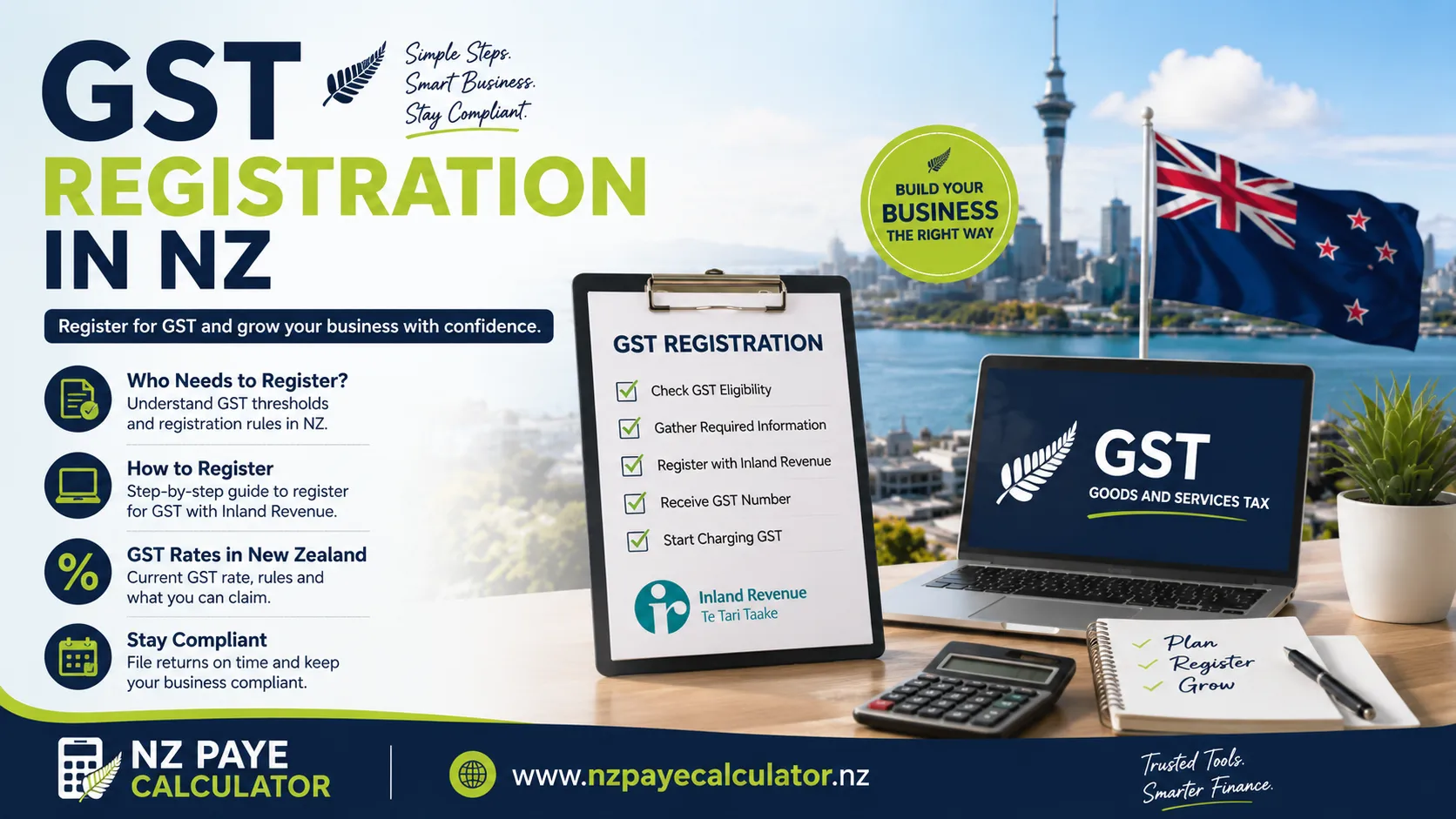
GST Registration In NZ
Do I Need to Register for GST in NZ? The $60,000 Threshold Explained (2026)
You must register for GST once your taxable turnover has exceeded or you reasonably expect it to exceed, $60,000 in any rolling 12 month period — not a calendar or tax year. The obligation starts the moment you expect to cross that threshold giving you 21 days to register, not 21 days after you have already gone over.
Already registered and just need the numbers? Use our free GST Calculator to add or remove GST instantly, including a multi-item invoice builder.
Table of Contents
This guide provides general information only, not tax advice. Confirm your specific registration obligation with Inland Revenue or a tax professional.
The $60,000 Threshold — What Actually Counts
The $60,000 figure is your taxable turnover — total GST-exclusive revenue from taxable supplies — not profit. It’s checked against a rolling 12-month window, meaning IRD looks at any 12 consecutive months, not your calendar year or financial year. A business could cross the threshold in month 7 of trading and be required to register immediately, well before any annual figure would suggest it.
| What counts toward the $60,000 | What doesn’t count |
|---|---|
| Sales of taxable goods and services | Wages/salary as an employee (your employer handles tax) |
| Most business income, GST-exclusive | Exempt supplies (e.g., residential rent, most financial services) |
| Expected future income you can reasonably forecast | Personal, non-business income |
Why the “Reasonably Expected” Rule Catches People Out
You don’t need to have already earned $60,000 — you need to register the moment you reasonably expect to cross that threshold within the next 12 months. This commonly trips up businesses that land one large contract: if a single job or client agreement will push your turnover over $60,000, you’re required to register before you invoice for it, not after.
Real consequence of getting this wrong: if you should have registered and charged GST but didn’t, you can become personally liable for the GST you failed to collect — IRD can still require you to pay it, even though you never charged your customer for it.
When Registration Is Optional (Voluntary Registration)
Below $60,000, registration is entirely your choice. Many small businesses register voluntarily anyway, particularly when they have significant upfront expenses — equipment, materials, professional fees — since registration lets you claim back the GST you paid on those business costs, even before you’re earning much revenue.
Common voluntary-registration scenarios:
- A new business with high setup costs (equipment purchases, initial stock)
- Property developers, early in a project, before sales revenue begins
- Exporters, since export sales are typically zero-rated (0% GST charged) while input GST on local costs remains fully claimable
Who Doesn’t Need to Register At All
| Situation | GST registration required? |
|---|---|
| Employee on PAYE (wages/salary only) | No — GST doesn’t apply to employment income |
| Turnover under $60,000, no significant deductible expenses | No, but optional |
| Supplies are entirely exempt (e.g., residential landlord, most financial services) | No — exempt supplies don’t count toward the threshold and can’t be GST-registered against |
| Hobby income, not a genuine business activity | Generally no |
What Happens After You Register?
Once registered, you must:
- Add 15% GST to your taxable sales
- File regular GST returns — monthly, two-monthly, or six-monthly (see our GST Due Dates 2026/27 calendar for exact deadlines)
- Keep GST-compliant invoices for 7 years
- Remit collected GST, minus GST paid on business expenses, to IRD each period
Frequently Asked Questions
What is the GST registration threshold in NZ?
$60,000 in taxable turnover within any rolling 12-month period — not a calendar year. You must register once you’ve exceeded this, or reasonably expect to.
Do I need to register for GST immediately once I hit $60,000?
You have 21 days to register from the point you exceed the threshold, or from when you reasonably expect to exceed it within the next 12 months — whichever comes first.
Can I register for GST voluntarily if I earn under $60,000?
Yes. Voluntary registration is common for businesses with significant deductible expenses, since it allows you to claim back GST paid on business costs even before reaching the compulsory threshold.
What happens if I don’t register when I should have?
You can become personally liable for GST you should have charged and collected but didn’t — IRD can still require payment, and continued non-compliance can lead to further penalties.
Does GST apply to my wages or salary?
No. GST only applies to business/taxable supplies. Employment income taxed through PAYE is entirely separate from GST.
Is the $60,000 threshold based on profit or revenue?
Revenue (taxable turnover), GST-exclusive — not profit. A business can be well under this threshold in profit terms while still being required to register based on turnover.
What is the cost of new GST registration in New Zealand?
GST registration in New Zealand is completely free. There is no fee charged by Inland Revenue (IRD) to register for GST. You can register online through the IRD’s myIR portal at no cost. The only financial obligation that comes with GST registration is that you must collect 15% GST on your taxable supplies and file regular GST returns — either monthly, two-monthly, or six-monthly depending on your turnover and preference.
How much can you earn without being GST registered in New Zealand?
In New Zealand you can earn up to $60,000 per year in taxable supplies without needing to register for GST. This is the compulsory GST registration threshold set by Inland Revenue. If your turnover from taxable activities exceeds $60,000 in any 12-month period — or if you expect it to exceed $60,000 in the next 12 months — you must register for GST.
If your turnover is under $60,000 you can still choose to register voluntarily, which allows you to claim back GST on your business expenses.