

Best KiwiSaver Providers in New Zealand 2026: Fees, Performance, Features & Ratings
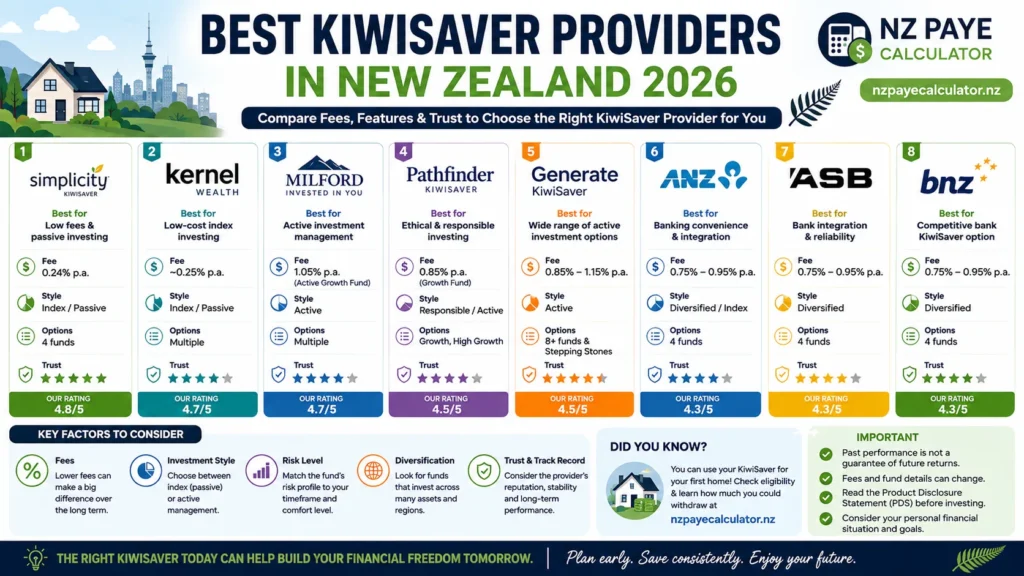
There is no single best KiwiSaver provider in New Zealand. The right choice for kiwisaver providers depends on you priorities like low fees, active management or ethical investing. Simplicity and Kernel lead on low fees around 0.24–0.31% p.a, Milford has the strongest long run active management track record, Pathfinder leads on ethical screening, BNZ is the most competitive bank affiliated option.
Already know your numbers? Project your own balance across different scenarios using our free KiwiSaver Calculator.
The “our comparison rating” scores in this article are an editorial assessment by nzpayecalculator.nz, based on publicly available fee schedules, Sorted Smart Investor data, Morningstar KiwiSaver Survey results, and FMA disclosures at the time of writing. They are not an official FMA, Morningstar, or government rating, and past performance is never a reliable indicator of future returns. This is general information, not personalised financial advice — see a licensed Financial Advice Provider for advice tailored to your situation.
Best KiwiSaver Providers NZ at a Glance
Here is top 10 kiwisaver providers
| # | Provider | Type | Growth fund fee (approx.) | Member fee | Best known for |
|---|---|---|---|---|---|
| 1 | Simplicity | Passive/index | 0.24%–0.31% p.a. | $30/year | Lowest overall cost, not-for-profit |
| 2 | Kernel | Passive/index | 0.25% p.a. | None | #1 3-year returns (Morningstar), fee transparency |
| 3 | BNZ | Hybrid (bank) | 0.40%–0.55% p.a. | $18/year | Cheapest bank-affiliated option, default provider |
| 4 | ASB | Active (bank) | 0.75%–1.00% p.a. | None | Slightly cheaper than ANZ, no member fee |
| 5 | ANZ | Active (bank) | 0.85%–1.06% p.a. | None | Largest membership base, convenience |
| 6 | Pathfinder | Active/ethical | 0.96%–1.28% p.a. | $27/year (waived under $1,000 or under 18) | Deepest ethical screening, B Corp certified |
| 7 | Westpac | Active (bank) | ~0.95% p.a. | None | Managed by BT Funds Management, similar fee tier to ANZ |
| 8 | Generate | Active | ~1.09% p.a. | ~$36/year | NZ/Australian-focused active management |
| 9 | Milford | Active | ~1.05% + performance fee (≈1.25% total) | $36/year | Strongest long-run active-management track record |
| 10 | Fisher Funds | Active | ~1.35% p.a. | Varies by fund | One of the more expensive providers; also owns SuperLife (a separate, low-cost passive scheme) |
Fees are indicative, sourced from Sorted Smart Investor and provider disclosures at time of writing — always confirm current fees in the provider’s Product Disclosure Statement before deciding.
Also Read: KiwiSaver First Home Withdrawal: Complete Guide 2026
How We Compare KiwiSaver Providers
Our comparison weighs eight factors: fees (the only variable guaranteed to affect your return, regardless of market conditions), historical performance (5-year minimum, ideally 10-year, after-fee figures — 1-year numbers are close to meaningless for manager skill), investment options (number and range of funds), risk levels (FMA’s standard 1–7 risk indicator), customer service reputation, ethical/responsible investing credentials, digital experience, and overall value (performance relative to fee, not fee or performance in isolation).
Two methodology notes worth understanding before reading the reviews below:
- Always compare after fee returns, not headline gross returns. A fund earning 8.5% gross with 1.2% fees delivers 7.3% net, a fund earning 8.0% gross with 0.31% fees delivers 7.69% net — materially better despite the lower headline number.
- A single year of outperformance means almost nothing. A growth fund that ranks #1 in one year is statistically no more likely to rank #1 the next. The FMA’s annual KiwiSaver report and Sorted’s Smart Investor tool remain the most authoritative independent NZ sources for after-fee, risk-adjusted returns by provider.
Simplicity KiwiSaver Review
Our comparison rating: 4.5/5 — Best for: lowest overall fees
Simplicity is a not-for-profit KiwiSaver manager that has built its entire identity around minimising cost. Its fee structure is among the lowest in the country: 0.24%–0.31% p.a. management fee depending on fund (with a flat $30/year member fee), and no performance fee. It donates 15% of revenue to charity rather than paying shareholder dividends.
Investment strategy: A globally diversified, passive index approach across NZ and international shares, primarily through low-cost index vehicles, tracking benchmarks like the NZX 50 and MSCI World.
Advantages: Genuinely the cheapest credible full-service option; regulated by the FMA with member assets held by an independent supervisor (Public Trust); simple, transparent structure.
Disadvantages: Digital experience is functional but less polished than newer providers like Kernel; less rigorous ethical screening than a dedicated ethical provider like Pathfinder.
Who it’s best for: Cost-conscious members of any age who want a simple, low-fee, passively managed fund and don’t need extensive fund customisation options.
Kernel KiwiSaver Review
Our comparison rating: 4.5/5 — Best for: transparent index investing, strong recent performance
Kernel is a newer (founded 2019), independent, index-focused manager built around radical fee transparency. Fees sit at a flat 0.25% p.a. on its diversified funds (High Growth, Balanced, Cash Plus), with no member fee and no admin fee — at least 39% below the industry average per Kernel’s own Morningstar-sourced comparison.
Investment strategy: Pure passive/index investing with an unusually wide range of individual index fund options for members who want to build a custom allocation, not just pick one diversified fund.
Performance: Kernel’s High Growth, Balanced, and Cash Plus funds ranked #1 for 3-year returns in their categories in the Morningstar KiwiSaver Survey to 31 March 2026. The High Growth fund also ranked number 1 for 1-year returns in its category.
Advantages: Best-in-class fee transparency; strong recent relative performance; broad fund customisation for engaged investors.
Disadvantages: A newer scheme (since 2019) means limited 10-year track record; more fund options can mean more decisions for members who just want simplicity.
Who it’s best for: Financially engaged members who want low-cost index investing with more granular control than Simplicity offers.
Milford KiwiSaver Review
Our comparison rating: 4/5 — Best for: active management with a genuine long-run track record
Milford is New Zealand’s best-known active KiwiSaver manager, running over NZ$8.4 billion in its Active Growth Fund alone across more than 103,000 members. It charges a base fund fee of ~1.05% p.a., plus a performance fee (up to 15% of returns above benchmark, subject to a high-watermark), bringing total fees to roughly 1.25% p.a. in a typical year, plus a $36/year member fee.
Performance: Over the 5 years to 31 March 2026, Milford’s Active Growth Fund returned 6.82% p.a. after fees and tax (at 28% PIR) — a figure that leads most other major growth funds over the same window, ahead of typical bank fund returns of roughly 5–6.5%. Milford has won the INFINZ Diversified Growth Fund Manager of the Year award four times in the past five years.
Advantages: Genuine, sustained after-fee outperformance versus most active peers over 5+ years; strong, consistent award recognition; was selected as a government default provider in 2021.
Disadvantages: Meaningfully higher fees than passive alternatives — Milford needs to outperform a low-cost passive fund by roughly 0.7%+ per year, every year, just to justify the fee premium; outperformance in any active fund is never guaranteed to continue.
Who it’s best for: Members comfortable paying a premium for professional active management with a demonstrated (though not guaranteed-to-continue) long-run edge.
Generate KiwiSaver Review
Our comparison rating: 3.5/5 — Best for: NZ/Australia-focused active management
Generate is an Auckland-based active manager, established 2013, and was one of the original nine default providers appointed in 2021. Fees run around 1.09% p.a. for its Growth fund, with a roughly $36/year member fee. Its Focused Growth fund offers a more concentrated, higher-conviction portfolio than the standard Growth fund.
Performance: Generate’s Growth and Focused Growth funds have delivered solid absolute returns over 5–10 year periods, though — per independent reporting including a 20 April 2026 RNZ comparison — lower-fee passive managers (Simplicity, Kernel, SuperLife) have recently outpaced well-known active managers including Generate on both 1-year and 3-year numbers.
Advantages: Established track record since 2013; NZ/Australian equity-heavy exposure appeals to members wanting local-market weighting; default provider status is a quality signal.
Disadvantages: Fees sit above the growth-fund category average without a clearly sustained performance edge to match, based on recent independent comparisons.
Who it’s best for: Members who specifically want active management with meaningful NZ/Australian market exposure, rather than a globally-weighted passive fund.
Pathfinder KiwiSaver Review
Our comparison rating: 4/5 — Best for: ethical/responsible investing
Pathfinder (founded 2009, B Corp certified) is New Zealand’s most explicitly values-driven KiwiSaver provider, applying its ethical framework across every fund rather than offering one bolted-on “ethical option.” Fees range from 0.96%–1.28% p.a. depending on fund, plus a $27/year member fee (waived for balances under $1,000 or members under 18).
Ethical credentials: UN Principles of Responsible Investment (UNPRI) signatory with an A+ governance rating; Responsible Investment Association of Australasia (RIAA) certified; Mindful Money’s “Best Ethical KiwiSaver Provider” award winner multiple years running; donates 20% of management fees to member-chosen charities.
Advantages: Genuinely rigorous ethical screening — excludes companies on both regulatory and broader societal/environmental harm grounds, not just a minimal weapons/tobacco exclusion list; strong independent ethical certifications.
Disadvantages: Mid-range fees for an active manager; smaller funds-under-management than the major providers (not necessarily a quality issue, but means less operating scale).
Who it’s best for: Members for whom ethical alignment is a primary, non-negotiable criterion in choosing a provider.
ANZ KiwiSaver Review
Our comparison rating: 2.5/5 — Best for: existing ANZ banking customers wanting convenience
ANZ is New Zealand’s largest KiwiSaver provider by membership, though it lost default-provider status in the 2021 government review. Growth fund fees run 0.85%–1.06% p.a., with no flat member fee (a fee ANZ removed in September 2021).
Advantages: Convenience for existing ANZ banking customers, integrated app experience, broad fund range including the older OneAnswer scheme for specialist options (NZ shares, property, infrastructure).
Disadvantages: Among the higher fee levels in the market — roughly $4,600 more over 10 years on a $50,000 balance compared to a 0.31% passive fund, before compounding on those fee savings is even factored in; lost default status specifically because its fee levels and fund structure didn’t meet the 2021 quality criteria.
Who it’s best for: Members prioritising banking convenience above fee minimisation — though it’s worth a genuine comparison against lower-fee alternatives if you’ve simply never reviewed the account.
ASB KiwiSaver Review
Our comparison rating: 2.5/5 — Best for: ANZ alternative with a slightly lower fee
ASB, like ANZ, was not selected as a 2021 default provider. Growth fund fees run 0.75%–1.00% p.a., marginally cheaper than ANZ, with no flat member fee — a small advantage for lower balances.
Advantages: Slightly more competitive fees than ANZ within the bank-affiliated tier; no member fee benefits smaller balances specifically.
Disadvantages: Still significantly more expensive than passive providers — the gap between ASB’s ~0.75%–1.00% and a 0.31% passive fund is roughly $3,000 over 10 years on a $50,000 balance.
Who it’s best for: Existing ASB banking customers who want to stay within their bank ecosystem but are choosing between ASB and ANZ specifically.
BNZ KiwiSaver Review
Our comparison rating: 3.5/5 — Best bank-affiliated provider
BNZ is the standout among bank-affiliated providers, and the only major bank scheme to retain 2021 default provider status. Growth fund fees run 0.40%–0.55% p.a. — notably lower than ANZ (0.85%+) and ASB (0.75%+) — plus an $18/year member fee.
Why BNZ kept default status when ANZ and ASB didn’t: the 2021 review set minimum fee caps and required default funds to be growth-oriented rather than cash-based. BNZ restructured ahead of the review to meet the new criteria; ANZ, ASB, and Westpac did not.
Advantages: Clearly the most competitive bank-affiliated provider on fees; hybrid approach blending passive index exposure with active decisions; new members defaulted into BNZ land in a Balanced fund, a materially better starting point than the old cash-fund default system.
Disadvantages: Still a meaningful fee premium over dedicated passive providers like Simplicity or Kernel, even if it’s the cheapest bank option.
Who it’s best for: Members who want to stay with a major bank provider but care enough about fees to specifically choose the best-value bank option rather than defaulting to their existing bank.
Best KiwiSaver Provider for Different Investors
| Investor type | Recommended starting point | Why |
|---|---|---|
| Best for low fees | Simplicity or Kernel | Both sit at 0.24%–0.31% p.a., far below the market average |
| Best for beginners | Simplicity | Simplest structure, one clear fund per risk level, minimal decisions required |
| Best for high-growth investors | Kernel High Growth or Milford Active Growth | Kernel for lowest-cost high growth exposure; Milford for active management with a track record |
| Best for ethical investing | Pathfinder | Deepest, most independently certified ethical screening in the market |
| Best for active management | Milford | Strongest sustained after-fee track record among active managers reviewed here |
| Best bank-backed provider | BNZ | Lowest fees among bank-affiliated options, plus retained default provider status |
KiwiSaver Fees Explained
Management fees are charged as a percentage of your balance annually — the single biggest cost lever, since it compounds against you every year regardless of returns.
Fund charges can include underlying fund costs (for funds that invest in other funds) and, for active managers like Milford, a performance fee layered on top of the base management fee.
Contribution costs — most NZ KiwiSaver providers charge no fee to contribute or switch funds/providers; switching is free by law, with no exit penalties permitted.
Why a small fee difference matters over decades: per Sorted’s industry benchmarks, 2026 average fees run roughly 0.90% for conservative funds, 1.01% for balanced, and 1.23% for growth. The difference between a 0.25% fund and a 1.25% fund can cost a typical member tens of thousands of dollars over a 30-year working life, purely from compounding fee drag — entirely separate from any difference in fund performance.
KiwiSaver Risk Profiles Explained
| Risk profile | Typical growth-asset allocation | Suited for |
|---|---|---|
| Conservative | ~20–30% growth assets | Short time horizon (under 3–4 years), or risk-averse investors near a withdrawal |
| Moderate | ~35–45% growth assets | Medium-short time horizon, wanting some growth with reduced volatility |
| Balanced | ~50–65% growth assets | Medium time horizon (5–10 years), moderate risk tolerance |
| Growth | ~70–90% growth assets | Long time horizon (10+ years), comfortable with market volatility |
| Aggressive/High Growth | ~95–100% growth assets | Very long time horizon (15+ years), high risk tolerance, typically younger members |
General principle: the longer your time horizon before you’ll withdraw (first home, or age 65), the more growth-asset exposure you can typically tolerate, since you have more time to ride out short-term volatility.
How to Choose the Best KiwiSaver Provider
- Determine your risk profile based on your time horizon (see table above) — this matters more than provider choice itself.
- Filter providers by fund availability at your risk level — not every provider offers every risk tier.
- Compare after-fee costs on your actual balance using Sorted’s Smart Investor tool, not just headline percentages.
- Check 5–10 year after-fee performance, not 1-year numbers, for any active fund you’re considering.
- Decide if ethical screening matters to you — if it does, weight this heavily, since it’s a values decision, not just a financial one.
- Review digital experience and customer service if you’ll want to self-manage your account regularly.
- Confirm current details directly on the provider’s Product Disclosure Statement (PDS) before switching or joining.
Should You Switch KiwiSaver Providers?
When switching may make sense: you’re paying meaningfully above-market fees without a demonstrated performance edge to justify it; your risk profile has changed (e.g., approaching a withdrawal); you were placed in a default provider/fund and never actively chose it; your values around ethical investing have shifted.
What to check before switching:
- Switching is free by law — no exit fees or break penalties are permitted for KiwiSaver transfers
- Your 3-year first home withdrawal eligibility clock is based on total KiwiSaver membership, not membership with any single provider — switching does not reset it
- You can only hold one active KiwiSaver account at a time
- Confirm the new provider’s fund actually matches your intended risk profile before transferring, rather than switching on fees alone
See our KiwiSaver Eligibility & How to Join guide for how enrolment and membership dates work.
KiwiSaver and Take-Home Pay
Your KiwiSaver contribution rate — 3.5% (default from 1 April 2026), or optionally 4%, 6%, 8%, or 10% — is deducted directly from your gross pay through PAYE, alongside income tax, the ACC earner’s levy, and any student loan repayment. Choosing a higher contribution rate genuinely reduces your take-home pay today in exchange for a larger retirement balance — a trade-off worth seeing in real numbers rather than estimating by feel.
See exactly how a KiwiSaver rate change affects your specific pay using our free PAYE Calculator, and project your resulting long-term balance with our KiwiSaver Calculator.
Frequently Asked Questions
What is the best KiwiSaver provider in NZ?
There’s no single best provider — it depends on your priorities. Simplicity and Kernel lead on low fees, Milford has the strongest active-management track record, Pathfinder leads on ethical investing, and BNZ is the most competitive bank-affiliated option.
Which KiwiSaver provider has the lowest fees?
Simplicity and Kernel are consistently the lowest, both around 0.24%–0.31% p.a. for growth/high-growth funds, well below the market average of roughly 1.23% p.a. for growth funds.
Which KiwiSaver fund has the best returns?
Over the 5 years to 31 March 2026, Milford’s Active Growth Fund returned 6.82% p.a. after fees and tax, among the strongest of the major growth funds compared here. However, past performance never guarantees future returns, and lower-fee passive funds have outperformed several active managers on more recent 1- and 3-year numbers.
Is Simplicity better than Kernel?
Both are excellent low-cost passive options. Simplicity offers the simplest structure with the certainty of no flat member fee scaling issue at very low balances; Kernel offers more fund customisation and has posted strong recent relative performance. Neither is objectively “better” — it depends on whether you want maximum simplicity or more granular control.
Is Milford KiwiSaver worth it?
Milford’s after-fee, after-tax 5-year performance has genuinely led most peers, which can justify its roughly 1.25% total fee for members comfortable with active management. Whether that premium is “worth it” depends on whether you believe the outperformance will continue — a judgment call, not a guarantee.
What is the best KiwiSaver for beginners?
Simplicity is generally the easiest starting point — a simple fund range, transparent flat fee, and no complex customisation decisions required.
Can I change KiwiSaver providers?
Yes, at any time, free of charge by law. Your 3-year first home withdrawal eligibility is based on total KiwiSaver membership, not membership with any single provider, so switching doesn’t reset that clock.
How often should I review my KiwiSaver?
At least annually, and any time your circumstances change significantly — a new job, approaching a withdrawal (first home or retirement), or a change in risk tolerance are all good triggers to check your fund and provider are still the right fit.
How can I check my KiwiSaver balance with Simplicity?
You can check Simplicity KiwiSaver balance anytime by logging into the Simplicity member app or your online account at app.simplicity.kiwi. Once logged in, you can view your current balance and transactions. You can also check your KiwiSaver information through myIR, although the balance shown there may differ because myIR does not include fund returns or voluntary contributions.
Quick method:
Open the Simplicity member app or online account.
Log in with your Simplicity credentials.
Your current KiwiSaver balance will be displayed in your account.
Check the transaction section for contributions and account activity.
Simplicity Member Login
How do I move my KiwiSaver to Kernel?
To move your KiwiSaver to Kernel, first create and verify a Kernel account then open the KiwiSaver section in your dashboard and choose the option to transfer your existing KiwiSaver balance. Kernel will contact your current provider and manage the transfer for you so you generally do not need to contact your old provider yourself. The transfer takes around 10 business days.
Which KiwiSaver scheme is the best in New Zealand?
There is no single best KiwiSaver scheme for everyone. The right choice depends on your risk level, investment timeframe, fees, services and long term performance. Providers such as Simplicity, Kernel, Milford, Pathfinder and Generate may suit different types of investors. Sorted recommends choosing a fund with an appropriate risk level, reasonable fees, useful services and solid performance compared with similar funds.