Fiscal Drag in New Zealand: How Bracket Creep Quietly Raises Your Tax
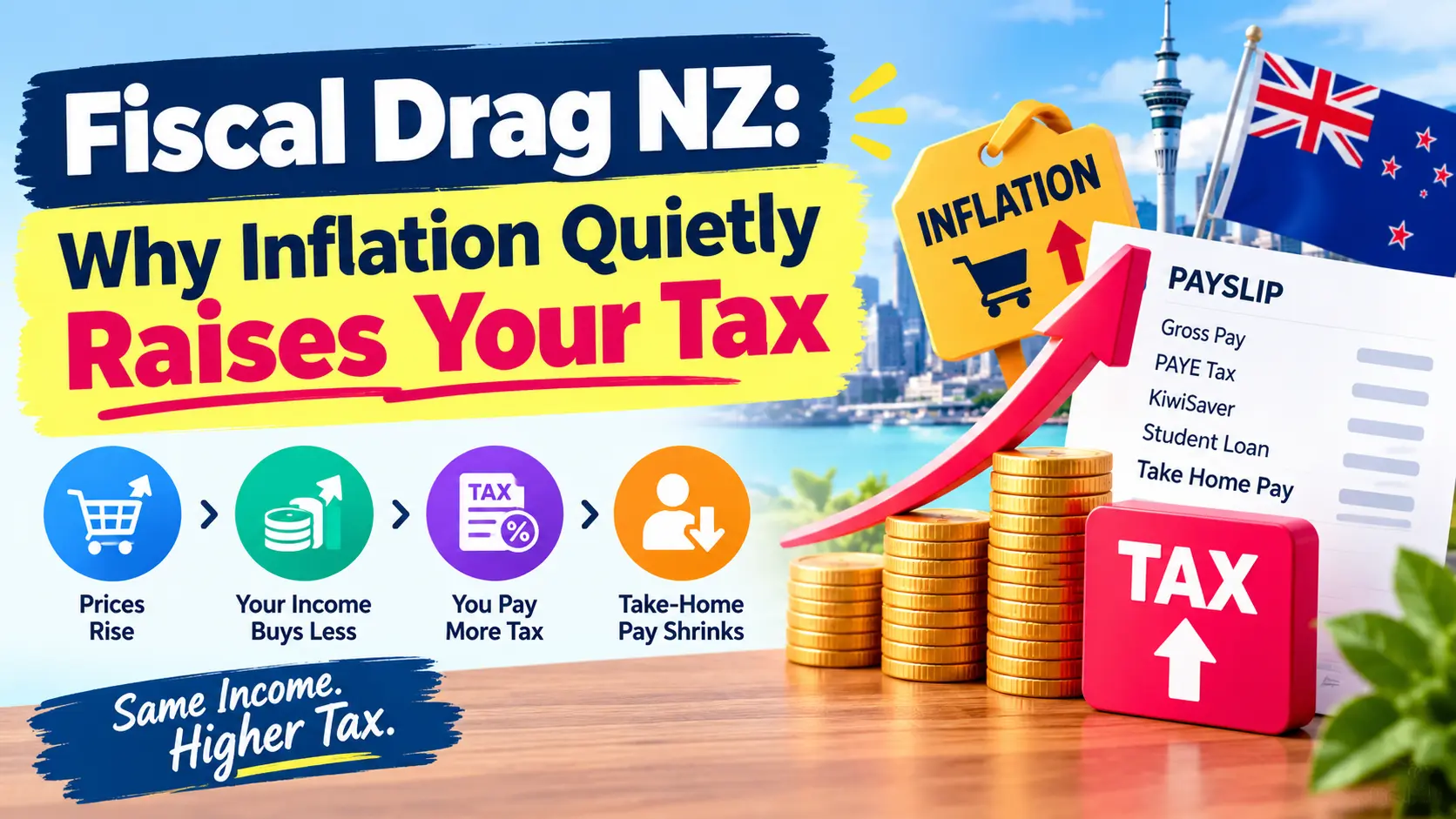
Fiscal drag (also called “bracket creep”) happens when tax brackets stay fixed while wages rise with inflation — pushing more of your income into higher tax brackets even though your real, inflation-adjusted purchasing power hasn’t actually improved. New Zealand’s brackets went 14 years unchanged (2010–2024) before a partial adjustment, and Budget 2026 confirmed no further bracket changes, so fiscal drag is actively continuing right now.
See exactly which bracket your income sits in using our free PAYE Calculator.
What Fiscal Drag Actually Is
Fiscal drag occurs because New Zealand’s income tax brackets are fixed dollar amounts, not automatically adjusted for inflation. If your pay rise simply keeps pace with inflation — meaning your real spending power stays exactly the same — a bracket system that doesn’t move still taxes more of that unchanged real income at a higher marginal rate, purely because the nominal dollar figure crossed a fixed threshold.
In plain terms: you can get a “raise” that leaves you no better off in real terms, yet still end up paying a noticeably higher share of your income in tax — not because tax policy changed, but because policy simply didn’t change while prices did.
The 14-Year Freeze — How Bad Did It Get?
New Zealand’s tax brackets were completely unchanged from 2010 to 2024 — the longest stretch without an adjustment in the modern tax system’s history. According to analysis reported via Newsroom, had the 30% threshold band been adjusted for inflation since 2010, it would have started at roughly $66,250 and ended around $96,614 by 2024. Instead, the actual 30% band sat at $53,501–$78,100 — meaning a significant chunk of middle-income earners’ pay was taxed at 30% that, under a fully inflation-indexed system, would have remained at the lower 17.5% rate.
The dollar cost, nationally: this analysis estimated middle-income New Zealanders were collectively paying roughly $2 billion more per year in tax than they would have under 2010-equivalent, inflation-adjusted brackets.
The 2024 “Fix” Only Reversed About a Third of It
On 31 July 2024, the government made the first bracket threshold adjustment in 14 years — lifting the bottom three thresholds to their current levels ($15,600 / $53,500 / $78,100). This was genuinely welcome relief, but according to Westpac chief economist Kelly Eckhold, it’s estimated to have reversed only about a third of the bracket creep that had accumulated up to that point. The other two-thirds of the inflation-driven tax increase built up since 2010 remains baked into the system.
Crucially, this was a one-off adjustment, not an ongoing commitment — New Zealand did not introduce automatic inflation indexing of tax brackets going forward, meaning fiscal drag resumed accumulating again immediately after the 2024 change.
Budget 2026 Confirmed — No Further Changes, Drag Continues
Budget 2026 (28 May 2026) confirmed no new income tax bracket changes. PAYE thresholds remain frozen at the levels set by the 31 July 2024 adjustment: 10.5% / 17.5% / 30% / 33% / 39%, at $15,600 / $53,500 / $78,100 / $180,000. The Independent Earner Tax Credit was also left unchanged at $10/week, with Treasury reportedly rejecting even a modest $5/week increase on cost grounds (estimated at $230–$560 million).
Why this matters right now: with inflation having spiked to 3.1% in the year to March 2026, and brackets confirmed frozen, fiscal drag isn’t a historical curiosity — it’s actively happening again, in real time, through 2026 and 2027.
(Source: NZ Herald — Is now the time to move tax brackets?; Budget 2026 announcements.)
Worked Example — Where Fiscal Drag Actually Bites
Treasury analysis cited by the NZ Herald found fiscal drag’s impact was largest for people earning around $70,000 in 2025 — right near the $78,100 threshold where the marginal rate steps up from 30% to 33%.
Illustrative example: Someone earning $68,000 receives a 4% pay rise purely to keep pace with inflation, taking them to $70,720. In real terms, they can buy exactly the same amount of goods and services as before — no improvement in living standards at all. But because $70,720 sits further into the 30% bracket than $68,000 did, and is now closer to crossing into the 33% band, a larger proportion of their income is taxed at the higher marginal rate than before the “raise” — despite zero actual improvement in their purchasing power.
Over a working lifetime, Treasury’s modelling suggests this effect compounds significantly: the October analysis noted that at 2% inflation and 1% real wage growth, personal tax revenue could rise by 2.1% of GDP between 2025 and 2038 under current fixed brackets — versus just 0.9% if brackets were indexed to inflation going forward.
Why Governments Don’t Simply Index Brackets to Inflation
This is a genuine, openly acknowledged policy trade-off, not an oversight. Fiscal drag is, in effect, an automatic, legislation-free way for tax revenue to grow alongside the economy without a government ever having to publicly announce a tax increase. As Westpac’s Kelly Eckhold noted, fiscal drag is “pro-cyclical” — it brings in more tax precisely when the economy (and wages) are growing, without any new legislation being required. Reversing it fully, on an ongoing basis, would mean deliberately giving up that automatic revenue growth — a real fiscal cost any government has to weigh against other priorities, including debt repayment.
Also Read: NZ Tax Codes 2026/27: M, ME, S, SH, ST, SB & SL Explained
Does NZ Superannuation Face the Same Problem?
No — and this is a telling contrast. NZ Superannuation is adjusted annually for inflation, by law. Income tax brackets are not. This asymmetry means retirees receiving NZ Super have their payments automatically protected against inflation’s erosion, while working-age taxpayers’ bracket thresholds simply sit still, absorbing the full effect of fiscal drag with no equivalent automatic protection.
See how this plays out on a real pay rise in our guide to how much of your pay rise you keep, check the current PAYE tax brackets, and compare incomes in our tax on salary breakdown.
Frequently Asked Questions
Were NZ tax brackets adjusted for inflation in 2024?
Yes, partially. The 31 July 2024 threshold change was the first adjustment since 2010, but economists estimate it reversed only about a third of the bracket creep that had built up over that 14-year period.
Will NZ tax brackets change again in 2026 or 2027?
Budget 2026 confirmed no new changes — PAYE thresholds remain frozen at the levels set in July 2024, meaning fiscal drag continues to accumulate as wages and inflation rise.
Who is most affected by fiscal drag in NZ?
Treasury analysis found the impact was largest for people earning around $70,000, close to the threshold where the marginal rate steps up from 30% to 33%.
Why doesn’t the government just index tax brackets to inflation?
Because fiscal drag functions as an automatic revenue increase without requiring new legislation. Indexing brackets would mean deliberately forgoing that revenue growth, a real trade-off against other fiscal priorities.
Is NZ Superannuation affected by fiscal drag the same way as wages?
No. NZ Superannuation is adjusted annually for inflation by law, while income tax brackets are not, creating an asymmetry between retirees’ protected payments and working taxpayers’ static bracket thresholds.