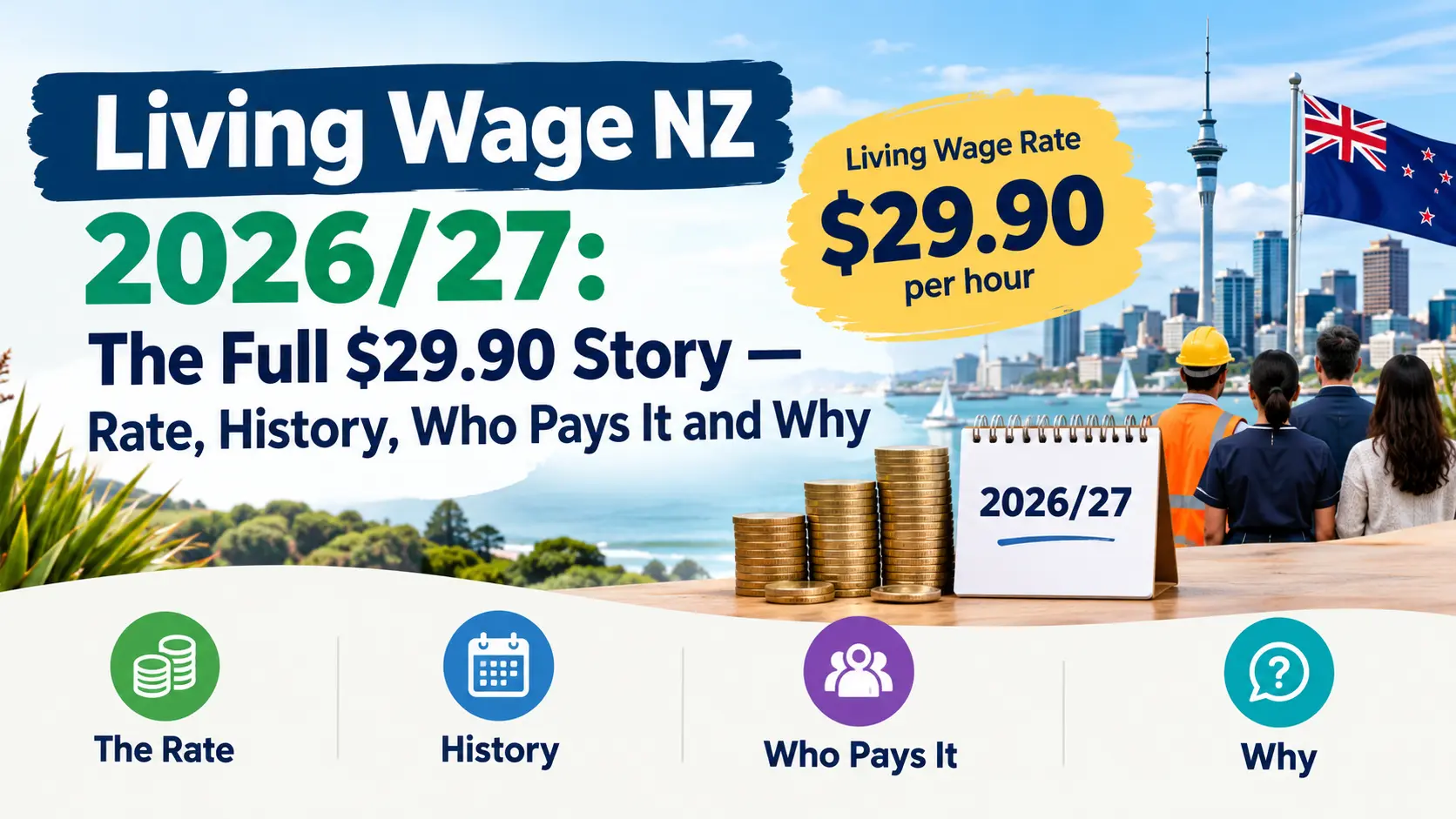
Living Wage NZ 2026/27: The Full $29.90 Story — Rate, History, Who Pays It and Why
Living Wage In New Zealand
The New Zealand Living Wage is $29.90 an hour, effective from 1 September 2026. At a standard 40-hour week that’s $1,196 a week and $62,192 a year in gross pay — about $12,376 more than someone on the legal minimum wage earns in the same year. Unlike the minimum wage, nobody has to pay it. Roughly 340 employers currently do anyway, covering more than 64,000 workers, because they’ve chosen to become accredited.
Table of Contents
Living Wage vs Minimum Wage: What’s Actually Different
| Minimum Wage | Living Wage | |
|---|---|---|
| Current rate | $23.95/hour | $29.90/hour |
| Set by | Government (MBIE) | Family Centre Social Policy Research Unit, on behalf of Living Wage Movement Aotearoa NZ |
| Legal status | Compulsory for almost all employers | Entirely voluntary |
| Changes on | 1 April | 1 September |
| Basis | Policy decision, reviewed annually | Calculated from actual household costs |
| Annual gross (40 hrs/wk) | $49,816 | $62,192 |
The minimum wage NZ is the floor. Nobody can legally be paid less. The Living Wage sits above that floor by design — it’s meant to represent what a worker actually needs to cover food, rent, transport, childcare and a bit of breathing room, rather than the lowest amount an employer can get away with paying.
How the Living Wage NZ Rate Is Actually Worked Out
The Living Wage NZ isn’t set by a committee vote or a political announcement. It’s calculated by the Family Centre Social Policy Research Unit, an independent research body, using Stats NZ’s Household Economic Survey data. The original 2013 methodology modelled a two-adult, two-child household with a combined 60 hours of paid employment between both adults, then worked out what hourly rate would cover that household’s food, rent, energy, health, communication, education, transport and childcare costs, with a small margin left over for savings and participating in ordinary community life — a birthday present, a school trip, that sort of thing.
Charles Waldegrave, the researcher who has led this calculation from the start, has described the goal plainly: the rate should sit modestly above what a family needs to get by, not at some aspirational or symbolic level. In recent years the figure has consistently landed at roughly 68% of the average ordinary-time hourly wage across the whole country, which is also how it’s adjusted in the years between full reviews — Stats NZ’s Quarterly Employment Survey tracks the movement in average hourly earnings, and the Living Wage moves roughly in step with it.
A full recalculation of the underlying methodology — going back to the actual cost data rather than just tracking wage movement — happens roughly every five years. The last full review was in 2023 and the next is due in 2028.
The Rate, Year by Year
Seeing the whole run of numbers tells you more than any single year’s figure does:
| Effective Date | Rate | Increase |
|---|---|---|
| 2013 | $18.40 | — (first rate) |
| February 2014 | $18.80 | +$0.40 |
| February 2016 | $19.80 | +$1.00 |
| July 2017 | $20.20 | +$0.40 |
| September 2018 | $20.55 | +$0.35 |
| September 2019 | $21.15 | +$0.60 |
| September 2020 | $22.10 | +$0.95 |
| September 2021 | $22.75 | +$0.65 |
| September 2022 | $23.65 | +$0.90 |
| September 2023 | $26.00 | +$2.35 |
| September 2024 | $27.80 | +$1.80 |
| September 2025 | $28.95 | +$1.15 |
| September 2026 | $29.90 | +$0.95 |
Thirteen years and the rate has gone up 62% in nominal terms. Note there wasn’t an update in 2015 — the schedule wasn’t strictly annual in the movement’s early years, before it settled into the current April-announcement, September-implementation rhythm.
The jump between 2022 and 2023 stands out — $23.65 to $26.00, close to a 10% increase in a single year. That wasn’t the movement suddenly deciding to be more generous; it reflects the same wage and cost-of-living inflation that pushed the government’s own minimum wage and benefit rates up sharply through that period.
Where the Gap to Minimum Wage Has Widened and Narrowed
Because the two rates are set by completely different processes on completely different timetables, the gap between them isn’t stable — it’s moved around a fair bit over the years. Between roughly 2018 and 2022, the minimum wage rose faster than the Living Wage calculation, and the gap between the two genuinely narrowed, down toward something like 15–20% at points. Since then the Living Wage has pulled back ahead, and as of September 2026 the gap sits at $5.95 an hour — the Living Wage is now about 25% above the minimum wage.
If you’re trying to use “the gap” as a proxy for how generous either rate is, it’s not a reliable one on its own — it tells you more about the relative pace of two separate calculations than about either rate’s real value.
Who Actually Pays It
Since the movement’s first accreditations in 2013, more than 360 organisations have gone through the process at some point; roughly 340 are currently accredited, which gives you a sense that a small number lapse or restructure out of the scheme each year rather than everyone who signs up staying forever.
The employer base is a genuinely mixed bag. Auckland Council has paid all directly employed staff the Living Wage NZ since 2017, with mayor Phil Goff extending the commitment to contracted cleaners not long after — a move the council’s own staff described at the time as a long-fought win rather than a quiet policy tweak. Wellington City Council, Christchurch City Council and a number of other local authorities followed a similar path, sometimes after genuinely heated council votes. Beyond local government, accredited employers now span universities, several district health boards and healthcare providers, community and social service organisations, a handful of major banks, and a long tail of small and mid-sized private businesses — everything from IT firms to hospitality operators to a well-known Rotorua bar.
Becoming accredited isn’t just a matter of raising wages and putting a badge on your website. Employers commit to paying the current rate to all directly employed staff and to workers delivering regular contracted services on their behalf — cleaners and security staff, most commonly, since these roles are often where outsourcing has historically been used to avoid paying decent wages. Accreditation is verified annually, and Living Wage Aotearoa can and does remove employers who stop meeting the criteria.
The Argument For It
The case made by the Living Wage Movement and its supporters isn’t purely about fairness in the abstract. Annie Newman, who has served as the movement’s national convenor, has argued for years that paying it makes plain financial sense on top of being the right thing to do — better recruitment, better staff retention, fewer sick days, higher morale, a more stable workforce that isn’t constantly being replaced and retrained. Some accredited employers echo this directly: a handful of small and mid-sized businesses that adopted the rate early have said publicly that turnover dropped noticeably once cleaning and hospitality staff were brought onto the Living Wage, offsetting some of the extra wage cost through lower recruitment and training expense.
There’s also a straightforwardly distributive argument behind the whole campaign. New Zealand has, at various points over the life of the movement, ranked in the bottom half of OECD countries on income inequality, and a meaningful share of children in material hardship live in households where at least one parent is working full-time. The Living Wage Movement’s founding argument in 2012 was that a job shouldn’t be a guarantee against poverty in name only.
The Argument Against It
The criticism has been just as consistent, and it’s worth representing fairly rather than glossing over. Business groups — Auckland’s Chamber of Commerce among the most vocal — have argued that the Living Wage isn’t tied to any measure of productivity or business performance, and that mandating or even socially pressuring pay rises unconnected to output is, in their words, simply bad business practice. The worry articulated most often is a knock-on or “compression” effect: if the lowest-paid staff get a jump to the Living Wage, staff who were previously earning a bit more than that expect a comparable increase to preserve the gap, and the cost ripples further through an organisation than the headline number suggests.
There’s a harder economic critique too, from labour economists who argue that any wage floor set above the market-clearing rate risks pricing some lower-skilled or entry-level workers out of employment altogether — the people the policy is meant to help ending up as the ones who can’t get hired in the first place. Economic commentary from firms like Infometrics has specifically challenged the calculation methodology itself, arguing the underlying household model doesn’t reflect how New Zealand households and welfare transfers actually work, and that upskilling the workforce might do more for low-wage workers long-term than a wage floor does. The methodology’s original author, Charles Waldegrave, has published detailed rebuttals to these critiques, arguing they misuse Stats NZ’s own survey data and offer no actual evidence for the productivity and morale concerns they raise.
Both sides of this argument have been making broadly the same points since 2013. Neither has conclusively settled it, and that’s worth knowing going in — the Living Wage is genuinely contested policy territory, not a settled consensus dressed up as one.
What $62,192 Actually Becomes After Tax
Gross pay isn’t take-home pay, and the gap matters more the higher up New Zealand’s tax brackets you go.
| Tax Bracket (2026/27) | Rate |
|---|---|
| $0 – $15,600 | 10.5% |
| $15,601 – $53,500 | 17.5% |
| $53,501 – $78,100 | 30% |
| $78,101 – $180,000 | 33% |
| $180,001+ | 39% |
A full-time Living Wage earner on $62,192 crosses into the 30% bracket for everything earned above $53,500 — a meaningfully bigger bite than someone on minimum wage, whose entire income stays within the 17.5% band.
Also Read: New Zealand Income Tax Rates And PAYE Tax Brackets 2026/27 – Complete IRD Guide
| Item | Annual |
|---|---|
| Gross pay | $62,192 |
| PAYE income tax (approx.) | –$10,878 |
| ACC earner’s levy (1.75%) | –$1,088 |
| KiwiSaver (3.5% default) | –$2,177 |
| Independent Earner Tax Credit | +$520 |
| Approximate net take-home pay | ~$48,570 |
That’s roughly $9,700 more take-home than a full-time minimum-wage worker keeps, against a gross gap of over $12,000 — a fair chunk of the extra pay disappears into the higher tax bracket rather than reaching the bank account. For your own exact figure, including whatever KiwiSaver rate you’re actually on and any student loan repayments, the NZ PAYE Calculator will do it properly rather than approximately.
The Previous Rate for Anyone Still Working Off Old Numbers
If you’re checking a job ad, payroll system, or accreditation document that hasn’t been updated yet, it may still show the 2025/26 rate:
| Rate Period | Hourly | Annual (40 hrs) |
|---|---|---|
| 1 Sept 2025 – 31 Aug 2026 | $28.95 | $60,216 |
| From 1 Sept 2026 | $29.90 | $62,192 |
Accredited employers have until 1 September each year to move over to the new rate — so there’s always a transition window where the old figure is still technically valid for anyone who hasn’t updated yet.
If You Don’t Work a Standard 40-Hour Week
Every figure above assumes 40 hours a week for 52 weeks. Real working patterns rarely look that tidy. If you’re part-time, casual, or working a different number of weeks a year, plug your actual hours into the Hourly to Salary Calculator to get your real annual figure rather than scaling the numbers above by hand.
Frequently Asked Questions
What is the Living Wage in New Zealand right now?
$29.90 an hour, effective from 1 September 2026. The previous rate, $28.95, applied from 1 September 2025 until 31 August 2026.
Is my employer legally required to pay me the Living Wage?
No. Unless your employer has specifically committed to Living Wage accreditation, they only need to meet the legal minimum wage of $23.95 an hour. The Living Wage is a voluntary standard not a law.
How is the Living Wage rate calculated?
Independently, by the Family Centre Social Policy Research Unit, based on the actual cost of food, housing, transport, childcare, health and other essentials for a reference household, drawn from Stats NZ’s Household Economic Survey. Between full methodology reviews (roughly every five years), it’s adjusted in line with movement in the average ordinary-time hourly wage.
How many employers pay the Living Wage in New Zealand?
Around 340 organisations are currently accredited, covering more than 64,000 workers, though over 360 have been accredited at some point since the scheme began in 2013.
Has the gap between the Living Wage and minimum wage always been the same?
No. It narrowed considerably between around 2018 and 2022, when the government raised the minimum wage faster than the Living Wage calculation moved, then widened again from 2023 onward. It currently sits at $5.95 an hour.
Is the Living Wage the same thing as an “average” or “median” wage?
No — it’s specifically calculated to reflect a basic-needs threshold, and has historically sat at around 68% of average ordinary-time hourly earnings, not the average itself.
Do accredited employers ever lose their accreditation?
Yes. Accreditation is reverified annually, and employers who stop meeting the criteria — paying all staff and regular contractors the current rate — can be removed from the scheme.