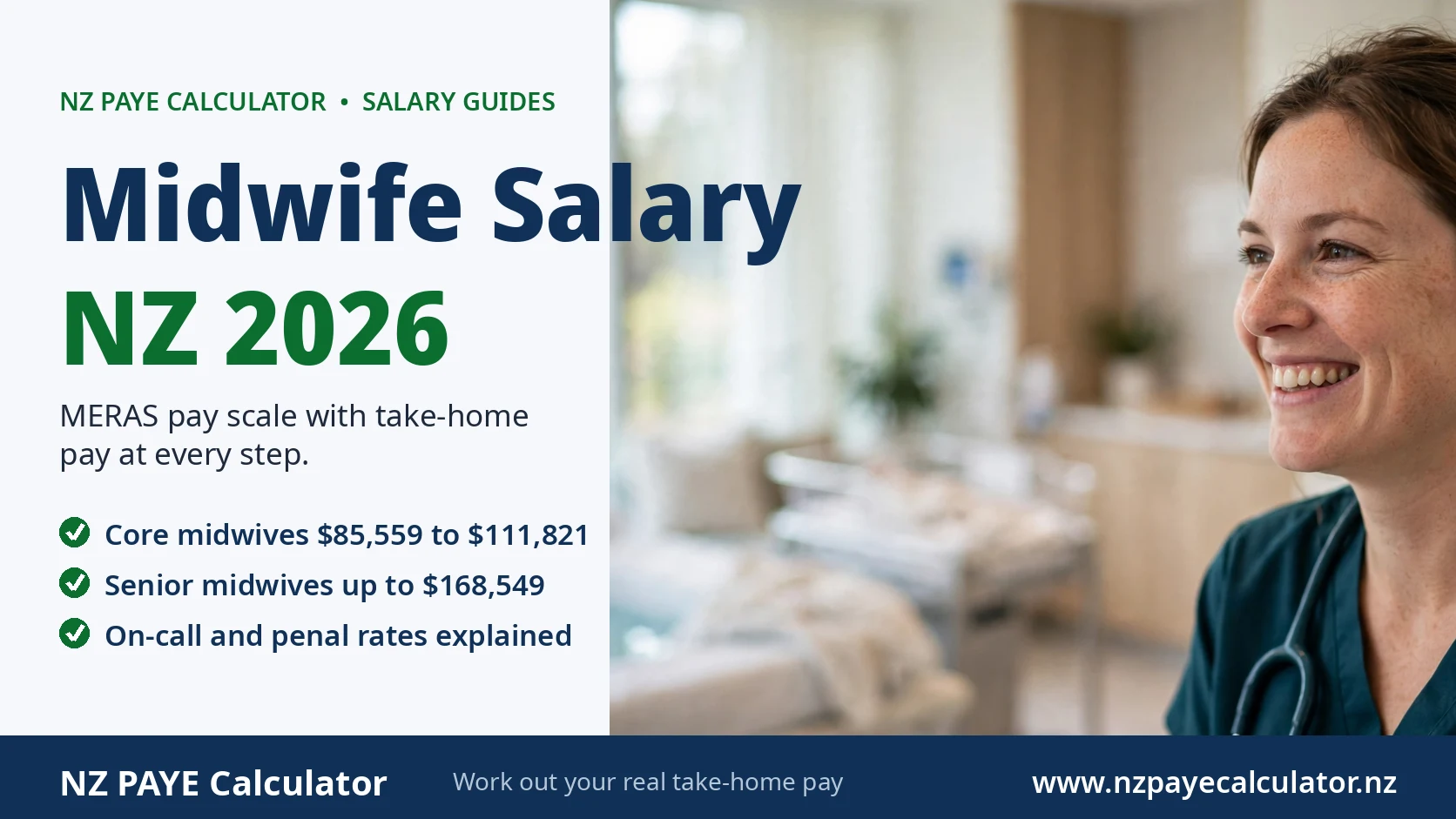
Midwife Salary NZ 2026: MERAS Pay Scale & Take-Home Pay Guide
Midwife pay in New Zealand is set by the collective agreement between Health New Zealand | Te Whatu Ora and MERAS, the midwives’ own union. The full scale is printed in the agreement — this guide shows every scale with take-home pay at every step, using the current rates that took effect on 1 June 2026. (A second agreement, the NZNO nursing and midwifery agreement, also covers some employed midwives; this guide uses the MERAS agreement. Self-employed LMC midwives are paid completely differently — see the last section.)
Quick Answer
An employed core midwife in NZ earns $85,559 at Step 2 rising to $111,821 at Step 7 — take-home pay of $65,950 to $83,086 a year after PAYE and ACC, before KiwiSaver. Community midwives top out higher at $119,799, caseload midwives earn $135,483 to $137,634, and designated senior midwives reach $168,549 at the top of Grade 8. On-call, overtime and penal rates are paid on top of these base rates.
Core Midwife Pay Scale (With Take-Home Pay)
Core midwives are the hospital and facility-based workforce. The scale runs from Step 2 to Step 7 — Step 1 carries no rate in the agreement, which is why Health NZ advertises the scale as Steps 2–7. Take-home pay uses the 2026/27 tax brackets and ACC levy, M tax code, before KiwiSaver and student loan:
| Step | Salary | Take-home / year | Take-home / fortnight |
|---|---|---|---|
| Step 2 | $85,559 | $65,950 | $2,537 |
| Step 3 | $90,628 | $69,257 | $2,664 |
| Step 4 | $95,512 | $72,444 | $2,786 |
| Step 5 | $105,648 | $79,058 | $3,041 |
| Step 6 | $108,724 | $81,065 | $3,118 |
| Step 7 | $111,821 | $83,086 | $3,196 |
Maternity care assistants, who work alongside midwives, earn $62,222 to $72,841 on their own five-step scale in the same agreement.
Community Midwife Pay Scale
Employed community midwives — who provide care in community settings rather than on a hospital roster — have an eight-step scale that runs slightly higher than the core scale:
| Step | Salary | Take-home / year |
|---|---|---|
| Step 2 | $86,631 | $66,649 |
| Step 3 | $91,767 | $70,000 |
| Step 4 | $96,714 | $73,228 |
| Step 5 | $106,986 | $79,931 |
| Step 6 | $111,655 | $82,977 |
| Step 7 | $114,345 | $84,733 |
| Step 8 | $119,799 | $88,291 |
Caseload Midwives
Employed caseload midwives work a continuity-of-care model — looking after a caseload of women right through pregnancy, birth and the postnatal period, organising their own hours to provide a 24-hour service (the NZCOM guideline caseload is 40–50 women a year). The two-step scale pays $135,483 (take-home $98,525) and $137,634 (take-home $99,929). Because of the model, penal rates and overtime do not apply to caseload midwives, except penal rates on public holidays.
Senior Midwife Pay Scale
Designated senior midwife roles — clinical specialists, educators, managers and coordinators — are graded 3 to 8 by the size of the job, not by years of service. Midwives step up within their grade each year; moving to a higher grade means appointment to a bigger role:
| Grade | Scale range | Take-home at top of grade |
|---|---|---|
| Grade 3 | $119,229 – $126,990 | $92,983 |
| Grade 4 | $121,336 – $133,507 | $97,236 |
| Grade 5 | $127,663 – $140,022 | $101,487 |
| Grade 6 | $132,949 – $144,371 | $104,325 |
| Grade 7 | $137,071 – $147,201 | $106,171 |
| Grade 8 | $141,644 – $168,549 | $120,309 |
How Midwife Pay Progression Works
- Annual increments: midwives move up one step on their anniversary date each year. Steps up to 5 are automatic; beyond that, progression is subject to satisfactory performance — which the agreement says is assumed unless the midwife is told otherwise.
- Experienced midwives can start higher: on appointment, the employer may place a midwife on any step of the scale, crediting previous midwifery experience.
- Increments keep running during full-time study leave and parental leave.
- Quality and Leadership Programme: midwives on the programme add a domain allowance to base pay — $3,000 a year at Confident level and $4,500 at Leadership level.
On-Call, Overtime and Penal Rates
- On-call allowance: $8.00 an hour for every hour rostered on call, and $10.00 an hour on public holidays. No midwife can be required to be on call for more than 40% of her off-duty time in any three-week period.
- Call-backs: being called in is paid as overtime with a minimum payment of 3 hours, and travel is provided or reimbursed.
- Overtime: time-and-a-half (T1.5) for the first 3 hours, then double time (T2).
- Penal rates: weekends add T0.5, public holidays T1, and night hours T0.25. Where overtime and penals could both apply, the higher rate is paid, not both.
- Registration paid: the employer meets the cost of the Annual Practising Certificate where it is required for the job, and full-time midwives get up to 32 hours of paid professional development leave a year.
Midwife Pay Rises: 2025 to 2027
The current MERAS agreement lifted all rates by 2.0% in June 2025 and a further 1.5% on 1 June 2026 — the rates on this page. The agreement contains no further scheduled increase and expires on 31 October 2027, so the next rise depends on the next bargaining round.
LMC Midwives: Paid Differently
Most community midwifery in NZ is provided by self-employed Lead Maternity Carers (LMCs), who are not salaried at all. LMCs claim fee-for-service payments for each module of care — antenatal, labour and birth, and postnatal — from the Crown under the Primary Maternity Services Notice 2021 (the notice formerly known as Section 88). The fees are set by the Crown, and LMCs must fund their own business costs, leave, tax and on-call availability out of them. Because the fee schedule is made up of many modules with selective uplifts over the years, there is no single official “LMC salary” figure — any average you see is an estimate, and it is not comparable with the employed scales above.
How to Become a Midwife in NZ
Midwifery is a registered profession. The pathway is a Bachelor of Midwifery from a Midwifery Council-accredited programme, passing the National Midwifery Examination, registration with the Midwifery Council of New Zealand, and an Annual Practising Certificate, renewed every year — you cannot legally practise without one. New graduates also enrol in the Midwifery First Year of Practice programme.
Work Out Your Own Take-Home Pay
Run any midwife salary through the NZ PAYE calculator, or compare professions in the nurse pay scale NZ guide, the paramedic salary NZ guide and the doctor salary NZ guide. See also take-home pay for every salary and take-home pay by hourly rate.
Frequently Asked Questions
How much does a midwife earn in NZ?
An employed core midwife at Health NZ earns $85,559 to $111,821 a year on the current MERAS scale (Steps 2–7, rates from 1 June 2026). Community midwives reach $119,799, caseload midwives $137,634, and senior midwives up to $168,549.
What is the highest midwife salary in NZ?
The top of the employed scale is Grade 8, Step 4 of the designated senior midwife scale: $168,549 a year, which is $120,309 take-home. Self-employed LMC midwives are paid per module of care instead of a salary, so they are not on this scale.
Do midwives move up the pay scale automatically?
Mostly, yes. Steps are annual increments on the anniversary date. Steps up to 5 are automatic, and beyond that progression is subject to satisfactory performance, which the agreement says is assumed unless the midwife is advised otherwise.
Can an experienced midwife start above Step 2?
Yes. On appointment the employer may place a midwife on any step of the scale, crediting previous midwifery experience or other relevant experience — you do not have to start at the bottom.
How much is the midwife on-call allowance?
On-call pays $8.00 an hour for all hours rostered on call, and $10.00 an hour on public holidays. If called back in, the work is paid as overtime with a minimum payment of 3 hours.
What qualification do you need to be a midwife in NZ?
A Bachelor of Midwifery, a pass in the National Midwifery Examination, registration with the Midwifery Council of New Zealand, and a current Annual Practising Certificate, which must be renewed every year.
Are LMC midwives paid a salary?
No. Self-employed Lead Maternity Carers claim fee-for-service payments per module of care under the Primary Maternity Services Notice 2021, and fund their own business costs, leave and on-call availability from those fees.
When is the next midwife pay rise?
The last scheduled rise under the current MERAS agreement took effect on 1 June 2026 (+1.5%). The agreement expires on 31 October 2027 and contains no further scheduled increase, so the next rise will come from the next bargaining round.
Compare Other NZ Profession Salaries
Compare the official pay scales for nurse pay scale NZ, doctor salary NZ, paramedic salary NZ, police salary NZ, firefighter salary NZ, corrections officer salary NZ, soldier salary NZ, social worker salary NZ, physiotherapist salary NZ and pharmacist salary NZ — every guide works out the take-home pay at each step.
Sources: Te Whatu Ora | Health New Zealand and MERAS, Midwives Collective Agreement, 1 June 2025 – 31 October 2027 (salary tables, clause 10.0; allowances Part Three); Health New Zealand, Midwives — Careers and job advertisements quoting the agreement; Midwifery Council of New Zealand — graduate registration; Ministry of Health, Primary Maternity Services Notice 2021. Rates shown are the 1 June 2026 column of the agreement. Take-home figures use the 2026/27 income tax brackets and ACC earner levy published by Inland Revenue and ACC, on the M tax code before KiwiSaver and student loan. General information only, not tax or career advice.