Firefighter Salary NZ 2026: FENZ Pay Scale & Take-Home Pay Guide
Firefighter pay in New Zealand is set by the collective agreement between Fire and Emergency NZ (FENZ) and the NZ Professional Firefighters Union (NZPFU). The agreement pays a total weekly wage for a 42-hour week, with steps for each rank and higher rates for firefighters qualified to drive the trucks. This guide shows the full scale — annualised from the agreement’s own tables — with take-home pay at every step. One thing to know up front: these rates have applied since 1 July 2023 and have not risen since, because the replacement agreement is still being bargained (see the pay rise section below).
Quick Answer
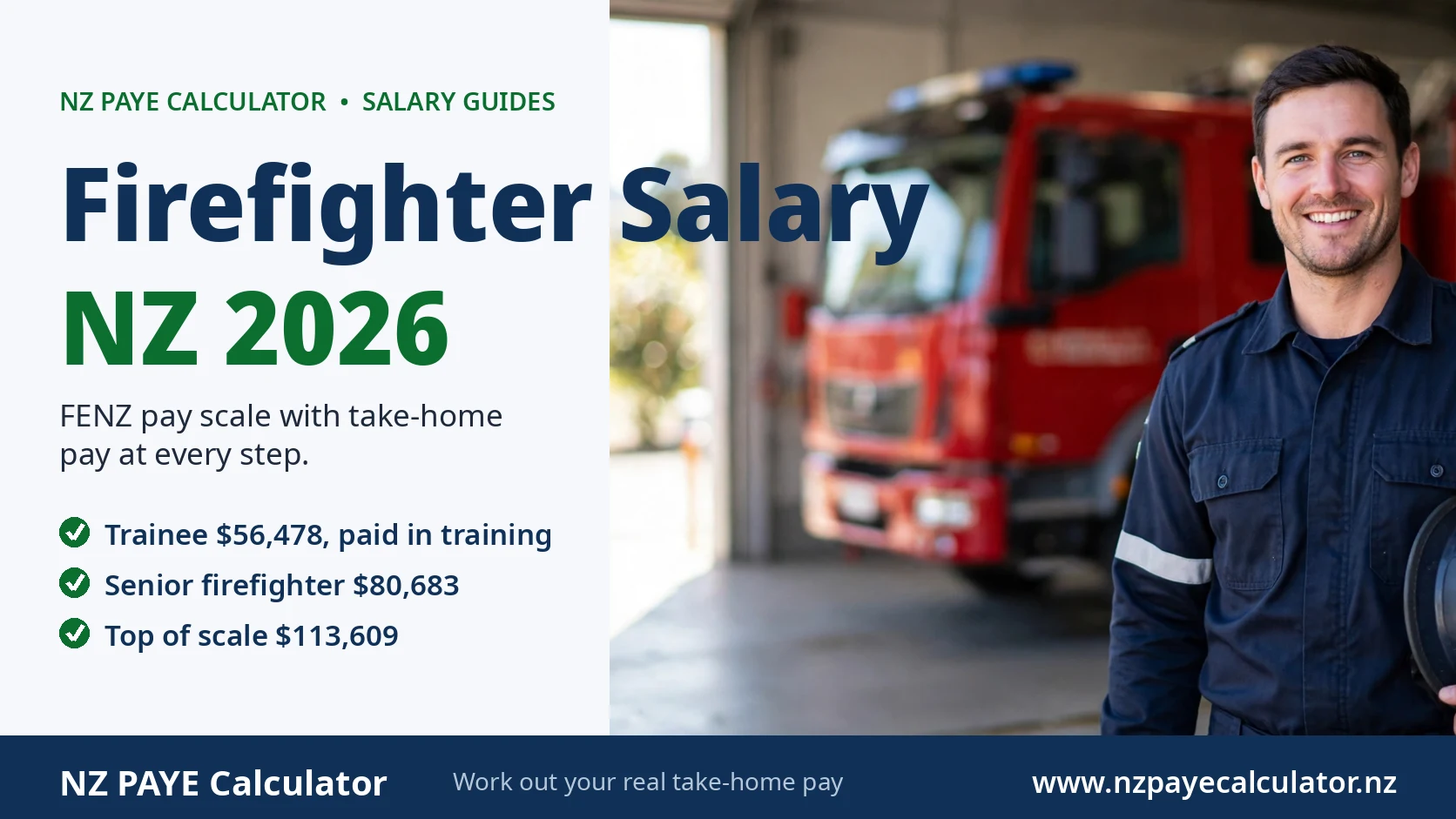
A trainee firefighter in NZ earns $56,478 a year, paid during training. A qualified firefighter earns $72,614, a senior firefighter $80,683, and the top of the scale — a senior station officer, executive officer qualified, driving Grade 1 — is $113,609 a year. Take-home pay runs from $46,326 for a trainee to $84,252 at the top step, after PAYE and ACC, before overtime and allowances. FENZ says overtime and allowances add an average of almost $39,000 a year for senior firefighters.
Firefighter Pay Scale (With Take-Home Pay)
Firefighters progress by training milestones (the TAPS programme) rather than time alone. Pay is set as a weekly wage in the agreement; the annual figures below are the weekly wage times 52, exactly as the agreement annualises it. Rates vary by driver qualification — the table shows the Non Driver rate and the top Grade 1 Driver rate. Take-home pay is on the Non Driver annual rate, 2026/27 tax brackets and ACC levy, M tax code, before KiwiSaver and student loan:
| Step | Annual (Non Driver) | Annual (Grade 1 Driver) | Take-home / year | Hourly (Non Driver) |
|---|---|---|---|---|
| Trainee Firefighter | $56,478 | — | $46,326 | $25.86 |
| Firefighter | $60,512 | $63,159 | $49,079 | $27.71 |
| Firefighter — Stage 1 QFF TAPS | $64,546 | $67,193 | $51,832 | $29.55 |
| Qualified Firefighter | $72,614 | $75,262 | $57,339 | $33.25 |
| Qualified FF — SFF TAPS modules 1–3 | $76,649 | $79,296 | $60,092 | $35.10 |
| Senior Firefighter | $80,683 | $83,330 | $62,768 | $36.94 |
| Senior FF — 10 years at rank | $82,700 | $85,347 | $64,084 | $37.87 |
| Senior FF — Station Officer Qualified | $84,717 | $87,364 | $65,400 | $38.79 |
The hourly rate is the weekly wage divided by 42 — firefighters are paid for a 42-hour week. FENZ publishes the same scale rounded: about $56,400 for a trainee, $60,500 for a firefighter, $72,600 for a qualified firefighter and $80,600 for a senior firefighter.
Station Officer Pay Scale
Officers step up annually for their first five years on satisfactory performance, then through senior station officer grades. Officers are tabled at driver grades only (no Non Driver rate):
| Step | Annual (Grade 2 Driver) | Annual (Grade 1 Driver) | Take-home / year (Grade 2) |
|---|---|---|---|
| Station Officer — on appointment | $91,865 | $93,434 | $70,064 |
| Station Officer — 1 year | $93,882 | $95,451 | $71,381 |
| Station Officer — 2 years | $95,899 | $97,469 | $72,697 |
| Station Officer — 3 years | $97,917 | $99,486 | $74,013 |
| Station Officer — 4 years | $99,935 | $101,503 | $75,330 |
| Station Officer — 5 years | $101,952 | $103,521 | $76,646 |
| Station Officer — SSO Qualified | $104,474 | $106,043 | $78,292 |
| Senior Station Officer | $106,996 | $108,565 | $79,937 |
| Senior Station Officer — Executive Officer Qualified | $112,040 | $113,609 | $83,228 |
How Firefighter Pay Progression Works
- Trainee to Firefighter: graduate the recruit course and you step up from $56,478 to $60,512.
- Qualified Firefighter within about two years, through the funded on-the-job TAPS development programme — worth $72,614.
- Senior Firefighter within about five years of joining for most firefighters, then two extra increments: 10 years at the rank, and qualifying as a station officer.
- Station Officer after at least two years as a senior firefighter and the Station Officer Programme, then five annual steps, the SSO-qualified step, senior station officer, and the top executive officer qualified step.
- Driver grades pay more at every step — up to about $2,650 a year more at senior firefighter level for a Grade 1 Driver.
Roster, Overtime and Allowances
- The roster: two day shifts (10 hours), two night shifts (14 hours), then four days off — an average 42-hour week. On night shifts firefighters rest on station between 11pm and 7am unless called out, with bedrooms provided.
- Overtime pays 1.5 times the usual rate. A full extra night shift (14 hours) pays 21 hours of usual pay; extending a shift at an incident pays a minimum of 3 hours.
- Overtime adds up: FENZ says overtime and allowances add an average of almost $39,000 a year to a senior firefighter’s remuneration, and experienced firefighters who work regular overtime earn over $100,000 a year.
- Super: firefighters can contribute up to 6% of salary to the Fire Superannuation Scheme and FENZ matches it at $1.52 for every $1 — far above the standard KiwiSaver employer rate.
- Other allowances: a $50 a week subsidy toward personal income protection or life insurance, a physical competency assessment allowance of $1,707 to $3,321 a year, a meal allowance of $18.93 per meal and a mess allowance of $5.62 a week.
- Leave: 14 consecutive days of rostered leave in each 160-day cycle, extra annual leave after 7 and 14 years, four weeks of sick leave a year, and 28 days of long service leave after 20 years.
Training: The Recruit Course
No previous qualifications are needed to become a firefighter. Training starts with a fully funded 12-week residential course at the National Training Centre in Rotorua, and recruits are paid the trainee rate — $56,478 a year — while they train. On graduation, trainees are posted to a station as firefighters on $60,512.
Firefighter Pay Has Not Risen Since 2023
The rates on this page took effect on 1 July 2023 and are still the current rates — firefighters have had no pay increase since then. Bargaining for a new agreement has run since July 2024. In October 2026 FENZ offered two increases of 2.2%; members rejected that offer in November 2026 ballots, so those higher figures sometimes seen online are not current pay. On 17 November 2026 the two sides agreed a new bargaining process with an independent facilitator, strike notices were withdrawn, and no strikes will be notified before 1 February 2027. When a settlement is agreed, this page will be updated with the new scale.
Work Out Your Own Take-Home Pay
Run any step through the NZ PAYE calculator, or compare professions in the police salary NZ guide, the nurse pay scale NZ guide and the teacher pay scale NZ guide. See also take-home pay for every salary and take-home pay by hourly rate.
Frequently Asked Questions
How much does a firefighter earn in NZ?
Firefighter pay runs from $56,478 a year for a trainee to $113,609 at the top of the officer scale. A qualified firefighter earns $72,614 and a senior firefighter $80,683 (Non Driver rates), before overtime and allowances. Rates have applied since 1 July 2023.
Do firefighter recruits get paid during training?
Yes. The 12-week recruit course at the National Training Centre in Rotorua is fully funded, and trainees are paid the trainee firefighter rate of $56,478 a year while they train. No previous qualifications are needed to apply.
How many hours do firefighters work?
An average of 42 hours a week, on a roster of two 10-hour day shifts, two 14-hour night shifts, then four days off. The pay scale hourly rate is the weekly wage divided by 42.
How much overtime do firefighters earn?
Overtime pays 1.5 times the usual rate, and a full extra night shift pays 21 hours of pay. FENZ says overtime and allowances add an average of almost $39,000 a year for senior firefighters, and experienced firefighters working regular overtime earn over $100,000.
How long does it take to become a senior firefighter?
Most firefighters reach Senior Firefighter within about five years: Qualified Firefighter is expected within about two years through the funded TAPS programme, then Senior Firefighter over the following two years or so.
What is the highest firefighter salary in NZ?
The top of the scale is $113,609 a year — a Senior Station Officer, Executive Officer Qualified, at the Grade 1 Driver rate. Take-home pay at that step is $84,252 a year before overtime and allowances.
When was the last firefighter pay rise?
1 July 2023. A FENZ offer of two 2.2% increases was rejected by union members in November 2026, and bargaining continues under a new process agreed on 17 November 2026, so no increase is currently scheduled.
Do firefighters get a good superannuation deal?
Yes. Firefighters can put up to 6% of salary into the Fire Superannuation Scheme and FENZ contributes $1.52 for every $1 the firefighter puts in — much more generous than the standard 3% employer KiwiSaver contribution.
Compare Other NZ Profession Salaries
Compare the official pay scales for nurse pay scale NZ, doctor salary NZ, midwife salary NZ, paramedic salary NZ, police salary NZ, corrections officer salary NZ, soldier salary NZ, social worker salary NZ, physiotherapist salary NZ and pharmacist salary NZ — every guide works out the take-home pay at each step.
Sources: Fire and Emergency NZ and NZPFU, Collective Agreement Part 5 pay tables, rates effective 1 July 2023; Fire and Emergency NZ, NZPFU Collective Employment Agreement explainer and OIA response Ref 21116 (8 May 2026); Fire and Emergency NZ news release, 4 December 2025; NZPFU notice to members, 17 November 2026. Rates current as at 24 November 2026. Take-home figures use the 2026/27 income tax brackets and ACC earner levy published by Inland Revenue and ACC, on the M tax code before KiwiSaver and student loan. General information only, not tax or career advice.