Physiotherapist Salary NZ 2026: Pay Scale & Take-Home Pay Guide
Physiotherapists in New Zealand do not have a physio-only national pay scale. Almost all Health NZ physiotherapists are paid on the degree-based allied health scale in the PSA Allied, Public Health, Scientific and Technical Collective Agreement — the same scale shared with occupational therapists, social workers and other degree-qualified allied health staff. This guide shows that full scale with take-home pay at every step, at the current rates from 1 December 2025, plus the designated senior grades, the separate APEX physiotherapy agreement used in three districts, and what Physiotherapy New Zealand’s own 2025 survey says about private practice pay.
Quick Answer
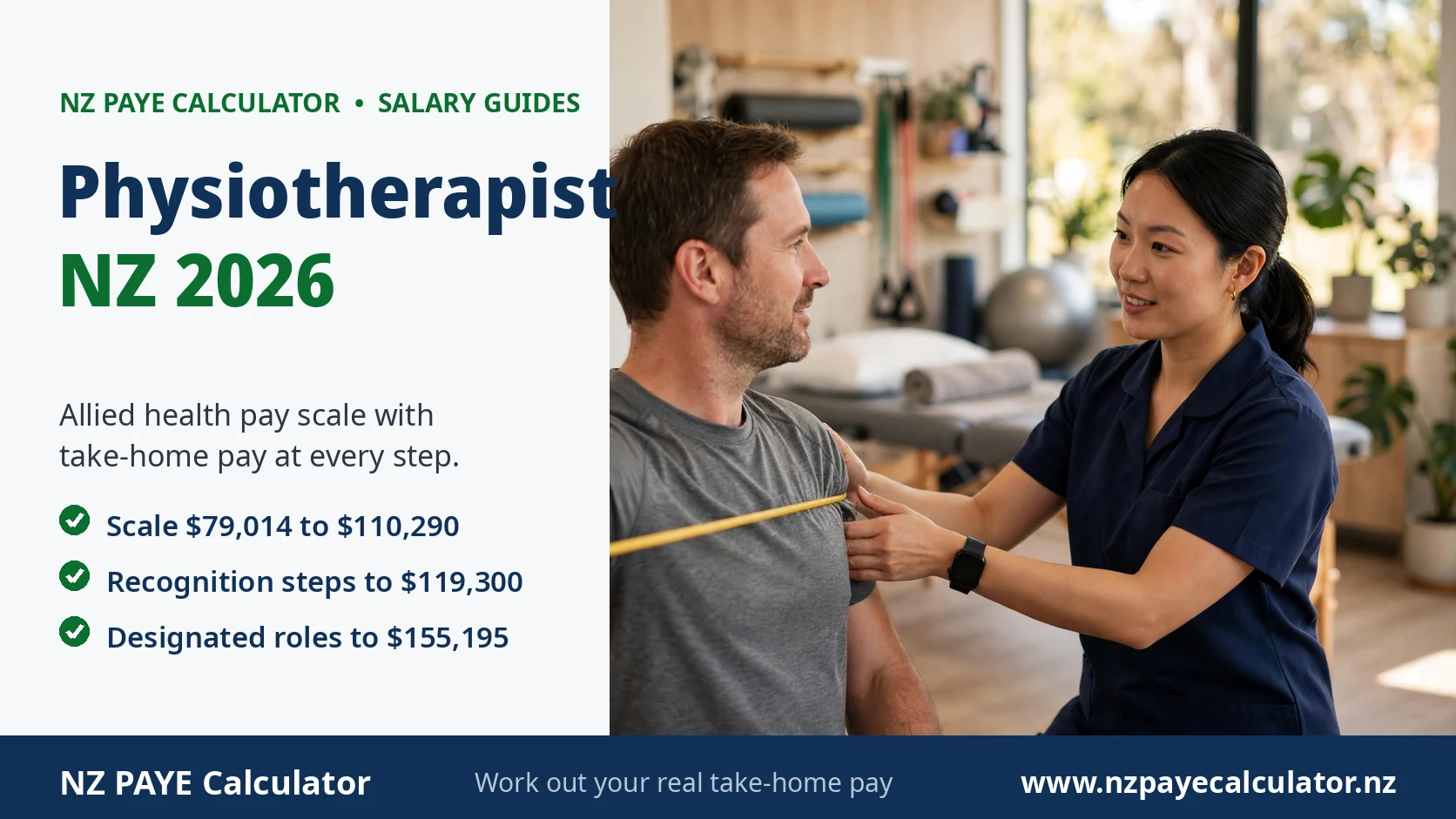
A Health NZ physiotherapist starts on $79,014 as a new graduate (take-home $61,679 a year) and climbs one step a year to $110,290 at Step 7, the top automatic step (take-home $82,087). Merit-based recognition steps reach $119,300, and designated senior, specialist and leadership roles reach $155,195. In private practice, Physiotherapy New Zealand’s 2025 remuneration survey puts the average at $89,599 gross — but on a full-time-equivalent basis public-sector physios average slightly more than private practice ($112,505 vs $105,599).
Physiotherapist Pay Scale (With Take-Home Pay)
The scale below is clause 5.2 of the PSA agreement — the degree-qualified core scale. Take-home pay uses the 2026/27 tax brackets and ACC levy, M tax code, before KiwiSaver and student loan. A further +2.0% step-up is already agreed for 7 December 2026:
| Step | Salary now | From 7 Dec 2026 | Take-home / year | Take-home / fortnight |
|---|---|---|---|---|
| Step 1 (new graduate) | $79,014 | $80,594 | $61,679 | $2,372 |
| Step 2 | $84,927 | $86,626 | $65,537 | $2,521 |
| Step 3 | $90,843 | $92,660 | $69,398 | $2,669 |
| Step 4 | $96,754 | $98,689 | $73,254 | $2,817 |
| Step 5 | $102,667 | $104,720 | $77,113 | $2,966 |
| Step 6 | $107,414 | $109,562 | $80,210 | $3,085 |
| Step 7 (top automatic) | $110,290 | $112,496 | $82,087 | $3,157 |
| Step 8 (additional progression) | $112,965 | $115,225 | $83,832 | $3,224 |
| Step 9 (recognition) | $116,133 | $118,455 | $85,899 | $3,304 |
| Step 10 (recognition) | $119,300 | $121,686 | $87,966 | $3,383 |
Designated Roles: Grades A to F
Designated positions are established roles carrying advanced clinical practice, clinical specialist, educator or leadership duties. Each grade is a range — physios step up within their grade each year, and a higher grade means appointment to a bigger role:
| Grade | Scale range | Take-home at top of grade |
|---|---|---|
| Grade A | $114,021 – $120,356 | $88,655 |
| Grade B | $120,356 – $125,634 | $92,099 |
| Grade C | $125,634 – $130,913 | $95,543 |
| Grade D | $130,913 – $136,192 | $98,988 |
| Grade E | $136,192 – $142,526 | $103,121 |
| Grade F | $142,526 – $155,195 | $111,387 |
The top of the structure, Grade F Step 4, is $155,195 (take-home $111,387), rising to $158,299 from 7 December 2026.
The APEX Physiotherapy Agreement (Three Districts)
In Bay of Plenty, Waikato and Northland, physiotherapists who belong to APEX are covered by a physiotherapist-specific agreement, the APEX Physiotherapy Collective Agreement (1 November 2025 – 31 October 2027), instead of the PSA agreement. It is a genuinely physio-only scale — but the dollar increases in it (+2.5%, then +2.0%) converge on exactly the same rates as the PSA scale by late 2026, so a physio’s pay does not depend on which union covers their district. Both agreements expire on 31 October 2027.
Private Practice Pay: The PNZ Survey
Private practice physios are not on any collective scale — pay is set by each clinic. The best evidence is Physiotherapy New Zealand’s Remuneration Survey 2025, the professional body’s own survey of more than 850 respondents:
- Average gross income: $89,599 across all respondents — pulled down by the large share of physios who work part-time.
- Full-time equivalent: $110,756 on an FTE-adjusted basis.
- Public vs private: FTE-adjusted, public-sector physios average $112,505 against $105,599 in private practice — the collective scale currently pays more than the average clinic job at the same hours.
- Business owners: clinic owners average $114,220 FTE-adjusted — the ownership route, not employment, is where private practice pulls ahead.
Treat single “average physiotherapist salary” figures from job sites with care — most mix part-time and full-time pay. The survey and the collective scale above are the two solid anchors.
How Physiotherapist Pay Progression Works
- Steps 1 to 7 are automatic: one step a year on your anniversary date, subject to satisfactory performance. That is roughly six years from new graduate to the top automatic step.
- Step 8 is earned: the Additional Progression Step requires agreed professional objectives set in advance, assessed after 12 months.
- Steps 9 and 10 are recognition steps: they reward demonstrated innovation, excellence, leadership or specialist skill, with only one step movement per year.
- Designated grades: placement is by job sizing and appointment — senior and specialist roles are advertised, not reached by time served.
- Entry is Step 1: the four-year bachelor degree is the minimum qualification for the scale, and there is no higher start for holding more than the minimum.
Penal Rates, On-Call and Allowances
- Weekend penal: +T0.5 on weekend hours (an enhanced +T1.0 applies in the Auckland districts); night: +T0.25; public holidays: +T1 plus a day in lieu.
- Overtime: T1.5, moving to T2.
- On-call allowance: $8.00 an hour while on call, $10.00 an hour on public holidays, plus a $15 flat remote-call rate; call-backs are paid with a 3-hour minimum.
- Higher duties: $3.00 an hour when acting in a higher role; meal allowance $7.95.
- Registration: the cost of the Annual Practising Certificate is addressed in the agreement (clause 18) for roles that require it.
Physiotherapist Pay Rises: 2025 to 2027
Rates rose 2.5% on 1 December 2025 (the current column above) and rise a further 2.0% on 7 December 2026 under the PSA agreement, with the APEX physiotherapy agreement matching the same dollars. Both agreements expire on 31 October 2027, so the next increase after December 2026 depends on the next bargaining round.
How to Become a Physiotherapist in NZ
The pathway is an accredited physiotherapy degree — offered by AUT, the University of Auckland, the University of Otago and Wintec — followed by registration with the Physiotherapy Board of New Zealand and an Annual Practising Certificate, renewed every year. You cannot legally practise as a physiotherapist in NZ without both. New graduates start on Step 1 of the Health NZ scale.
Work Out Your Own Take-Home Pay
Run any physiotherapist salary through the NZ PAYE calculator, or compare professions in the pharmacist salary NZ guide, the nurse pay scale NZ guide and the social worker salary NZ guide. See also take-home pay for every salary and take-home pay by hourly rate.
Compare Other NZ Profession Salaries
Compare the official pay scales for nurse pay scale NZ, doctor salary NZ, midwife salary NZ, paramedic salary NZ, police salary NZ, firefighter salary NZ, corrections officer salary NZ, soldier salary NZ, social worker salary NZ and pharmacist salary NZ — every guide works out the take-home pay at each step.
Frequently Asked Questions
How much does a physiotherapist earn in NZ?
A Health NZ physiotherapist earns $79,014 to $110,290 on the allied health collective scale (Steps 1–7), with recognition steps to $119,300 and designated senior roles to $155,195. Private practice pay varies by clinic; Physiotherapy New Zealand’s 2025 survey averages $110,756 on a full-time-equivalent basis.
How much does a new graduate physiotherapist earn in NZ?
New graduates start on Step 1 of the Health NZ scale: $79,014 a year from 1 December 2025, which is $61,679 take-home. The rate rises to $80,594 from 7 December 2026.
Do physiotherapists earn more in private practice or hospitals?
On the best available evidence, hospitals currently pay slightly more at the same hours: PNZ’s 2025 survey puts the FTE-adjusted public average at $112,505 versus $105,599 in private practice. Private practice pulls ahead mainly for clinic owners, who average $114,220.
What is the highest physiotherapist salary in NZ?
The top of the Health NZ structure is Designated Grade F Step 4: $155,195 a year ($111,387 take-home), rising to $158,299 from 7 December 2026. It is a recognition step within a designated leadership or advanced clinical role.
Do physiotherapists move up the pay scale automatically?
Steps 1 to 7 are annual increments. Step 8 requires agreed objectives, and Steps 9 and 10 are recognition steps for demonstrated excellence and leadership — those are earned, not automatic.
What qualification do you need to be a physiotherapist in NZ?
An accredited physiotherapy degree (AUT, University of Auckland, University of Otago or Wintec), registration with the Physiotherapy Board of New Zealand, and a current Annual Practising Certificate renewed every year.
When is the next physiotherapist pay rise?
The next scheduled increase is +2.0% on 7 December 2026 under the PSA agreement, with the APEX physiotherapy agreement converging on the same dollars. Both agreements expire on 31 October 2027.
Sources: PSA and Health New Zealand, Allied, Public Health, Scientific and Technical Collective Agreement, 1 December 2025 – 31 October 2027 (degree-qualified scale, clause 5.2); APEX and Health New Zealand, Physiotherapy Collective Agreement, 1 November 2025 – 31 October 2027; Physiotherapy New Zealand, Remuneration Survey 2025; Physiotherapy Board of New Zealand — graduate pathway; Health New Zealand, Physiotherapists — Careers. Take-home figures use the 2026/27 income tax brackets and ACC earner levy published by Inland Revenue and ACC, on the M tax code before KiwiSaver and student loan. General information only, not tax or career advice.