Nurse Pay Scale NZ 2026: Registered Nurse Salary & Take-Home Pay Guide
Registered nurses in New Zealand are paid on one national pay scale, set by the collective agreement between Health New Zealand | Te Whatu Ora and the NZNO nurses’ union. The current rates apply from 2 March 2026. This guide shows the full scale — registered nurses, enrolled nurses and senior grades — with the take-home pay at every step after PAYE and ACC, which no other nurse salary guide publishes. It also covers penal rates and allowances, how progression works, and the pay rise already locked in for March 2027.
Quick Answer
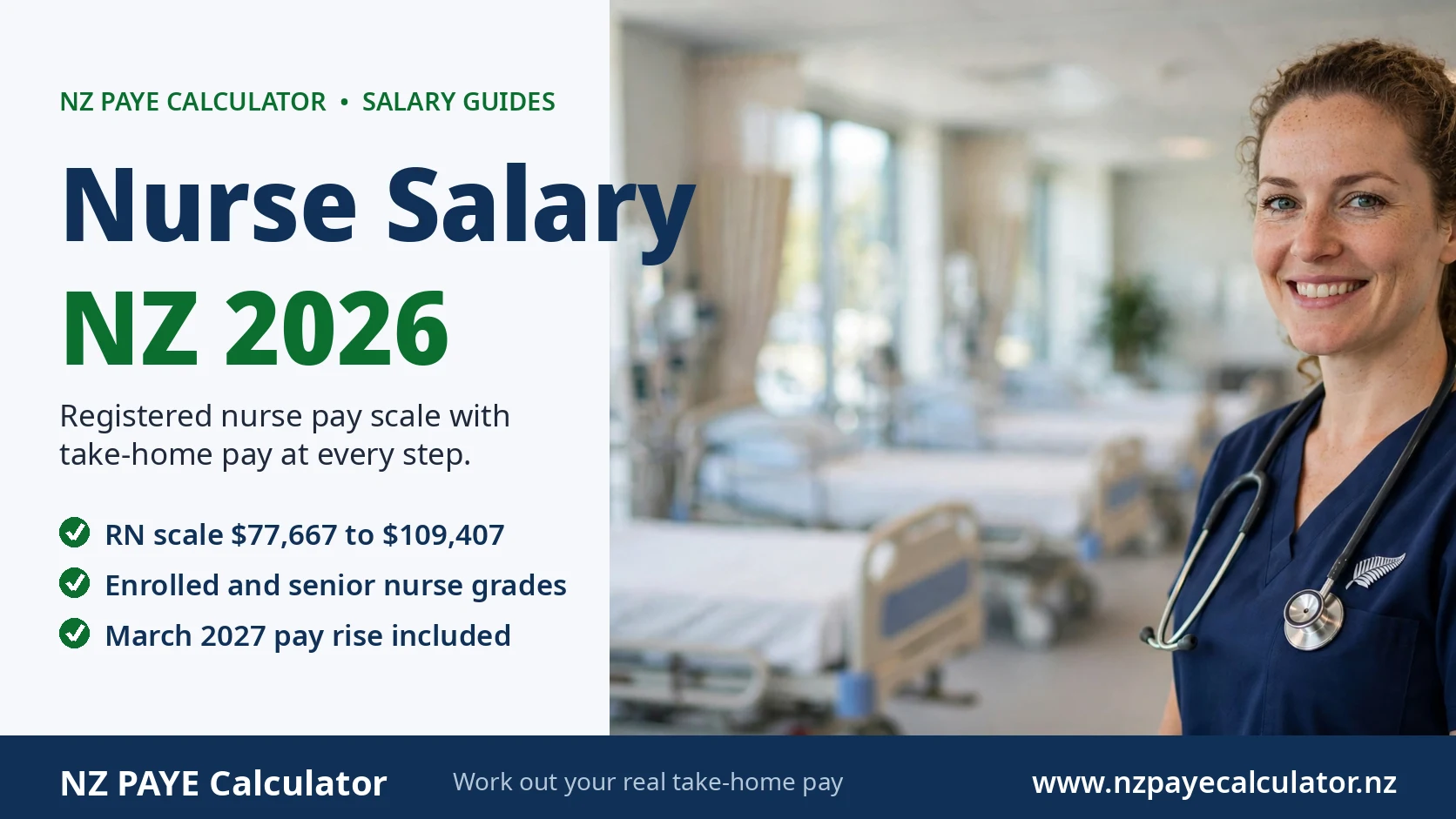
A registered nurse in NZ earns $77,667 a year as a new graduate (Step 1), rising to $109,407 a year at Step 7, the top of the RN scale. Take-home pay is $60,787 a year at Step 1 and $81,511 a year at Step 7 — $2,338 to $3,135 a fortnight — after PAYE income tax and the ACC earner levy, before KiwiSaver and any student loan. Designated senior nurses earn up to $166,872, and Nurse Practitioners are paid on that same top grade.
Registered Nurse Pay Scale 2026 (With Take-Home Pay)
The full RN scale from the Health NZ – NZNO Nursing and Midwifery Collective Agreement (clause 8.0.1). Take-home figures use the 2026/27 tax brackets and the ACC earner levy of 1.75%, on the M tax code, before KiwiSaver and student loan deductions.
| Step | Salary 2026 | Take-home / year | Take-home / fortnight | Salary from Mar 2027 |
|---|---|---|---|---|
| Step 1 (new graduate) | $77,667 | $60,787 | $2,338 | $79,221 |
| Step 2 | $83,725 | $64,753 | $2,491 | $85,400 |
| Step 3 | $88,682 | $67,988 | $2,615 | $90,456 |
| Step 4 | $93,458 | $71,104 | $2,735 | $95,328 |
| Step 5 | $103,370 | $77,571 | $2,984 | $105,438 |
| Step 6 | $106,344 | $79,512 | $3,058 | $108,471 |
| Step 7 | $109,407 | $81,511 | $3,135 | $111,596 |
In hourly terms, the agreement works the RN rate out as the annual salary divided by 2,086 hours: about $37.23 an hour at Step 1 and $52.45 an hour at Step 7, before penal rates. A nurse reaches the top step after about six years, moving up one step a year (see progression below). To see any step as a plain salary, the salary after tax pages show the same take-home maths for round figures.
Enrolled Nurse Pay Scale 2026
Enrolled nurses (including obstetric, Karitane and assistant nurses) sit on their own five-step scale in the same agreement (clause 8.0.2):
| Step | Salary 2026 | Take-home / year | Take-home / fortnight |
|---|---|---|---|
| Step 1 | $71,682 | $56,702 | $2,181 |
| Step 2 | $74,810 | $58,837 | $2,263 |
| Step 3 | $80,337 | $62,542 | $2,405 |
| Step 4 | $82,886 | $64,206 | $2,469 |
| Step 5 | $87,433 | $67,173 | $2,584 |
The Step 5 rate includes a flat $2,000 adjustment on top of the 2026 increase, recognising the enrolled nurse scope of practice. An enrolled nurse who later qualifies as a registered nurse is appointed to an RN step no lower than their previous salary.
Senior Nurse and Nurse Practitioner Pay
Designated senior nurses — charge nurses, clinical nurse specialists, nurse educators and nurse managers — are paid on six grades (clause 8.0.5). Where a nurse sits in a grade depends on the size and responsibility of the role:
| Grade | Salary range 2026 | Take-home at top step |
|---|---|---|
| Grade 1 | $116,876 – $124,480 | $91,346 |
| Grade 2 | $118,941 – $130,866 | $95,513 |
| Grade 3 | $125,138 – $137,250 | $99,678 |
| Grade 4 | $129,277 – $141,508 | $102,456 |
| Grade 5 | $133,408 – $144,283 | $104,267 |
| Grade 6 | $140,235 – $166,872 | $119,186 |
Nurse Practitioners are paid on the Grade 6 scale — $140,235 to $166,872 — plus a professional development allowance of $6,000 a year from March 2026. Health care assistants, who work alongside nurses, earn $61,603 to $72,117 on their own five-step scale in the same agreement.
How Nurse Pay Progression Works
- One step a year, automatically. Nurses move up one step on the anniversary of their appointment each year. Steps 6 and 7 also require satisfactory performance — which is assumed unless the nurse is told otherwise.
- Experience counts at appointment. The employer can place a nurse on any step, including Steps 6 and 7, crediting previous nursing experience. An experienced nurse joining from overseas does not have to start at Step 1.
- Senior grades work differently. Placement in a senior grade is based on the role’s size and responsibility; nurses move within a grade each year, and move between grades only by changing roles.
- Same pay everywhere. The scale is national, so the same step pays the same base salary in every Health NZ district, from Auckland to Invercargill.
Penal Rates, Overtime and Allowances
Base salary is only part of a nurse’s pay. The agreement adds penal rates for unsocial hours (T1 = the ordinary hourly rate):
- Weekends: an extra T0.5 — time-and-a-half in total — for ordinary hours worked across the weekend.
- Nights: an extra T0.25 for hours worked from 8pm through a night duty.
- Public holidays: an extra T1 — double time in total — plus an alternative holiday (a day in lieu).
- Overtime: T1.5 for the first 3 hours beyond the rostered duty, then T2; weekend and night overtime is paid at T2. A call-back pays a minimum of 3 hours.
- On-call allowance: $8.00 an hour while on call, $10.00 an hour on public holidays.
- PDRP allowances: $3,000 a year at Proficient level and $4,500 a year at Expert level under the Professional Development and Recognition Programme, paid on top of salary.
- Higher duties: $3.00 an hour when substantially covering a higher-graded role; a shift coordinator allowance of $24 per shift also applies.
- Practising certificate: Health NZ pays the cost of the annual practising certificate where the role legally requires one — nurses do not pay it themselves.
The Nurse Pay Rise Coming in March 2027
The current agreement already locks in the next rise: +2.0% on all rates from 2 March 2027. Step 1 rises to $79,221 and Step 7 to $111,596, as shown in the last column of the RN table above. The agreement then runs to 31 October 2027. A parallel agreement with the Nurses Society of NZ carries the identical dollar rates, taking effect on 6 April 2026 and 6 April 2027 for its members.
How to Become a Registered Nurse in NZ
Registration is through the Nursing Council of New Zealand. NZ graduates need a Nursing Council-approved bachelor’s degree in nursing (or an approved graduate or postgraduate nursing qualification), a pass in the Council’s competence assessment, and a pass in the state final examination. Once registered, a nurse must hold a current annual practising certificate to work. Internationally qualified nurses register through the Council’s overseas pathway, and their NZ employer can credit their experience on the pay scale as described above.
Work Out Your Own Take-Home Pay
Run your own step, hours and KiwiSaver rate through the NZ PAYE calculator. You can also compare nursing with teaching in the teacher pay scale NZ guide, browse take-home pay for every salary, or check take-home pay by hourly rate.
Frequently Asked Questions
How much does a new graduate nurse earn in NZ?
A new graduate registered nurse starts on Step 1 of the Health NZ scale: $77,667 a year from 2 March 2026, which is $60,787 take-home ($2,338 a fortnight) after PAYE and ACC. The rate rises to $79,221 from 2 March 2027.
What is the highest nurse salary in NZ?
The top of the registered nurse scale is $109,407 at Step 7. Designated senior nurses earn up to $166,872 (Grade 6), and Nurse Practitioners are paid on that same Grade 6 scale, plus a $6,000 professional development allowance.
How long does it take to reach the top of the nurse pay scale?
About six years. Nurses move up one step a year automatically on their appointment anniversary, so a new graduate reaches Step 7 after roughly six years of service. Experienced nurses can be placed on a higher step from day one.
Do nurses get paid extra for weekends and nights?
Yes. Weekend work adds T0.5 (time-and-a-half in total), night work adds T0.25, and public holidays add T1 (double time) plus a day in lieu. These penal rates are set in clause 8.2 of the collective agreement.
How much is the nurse on-call allowance?
$8.00 for every hour on call, rising to $10.00 an hour on public holidays. If a nurse is called in, the call-back is paid at overtime rates for a minimum of 3 hours.
Is nurse pay the same across New Zealand?
Yes, for Health NZ hospital nurses. The scale is set by one national collective agreement, so the same step pays the same base salary in every district. Private and primary care nurses sit under separate agreements, and mental health nurses in a few districts are covered by the PSA agreement instead.
What does a nurse take home on $100,000?
A salary of $100,000 sits between RN Steps 4 and 5. Take-home pay on $100,000 is about $75,373 a year after PAYE and ACC — see the $100,000 after tax page for the full breakdown.
When is the next nurse pay rise?
The agreement already includes a 2.0% increase from 2 March 2027, taking Step 1 to $79,221 and Step 7 to $111,596. The agreement expires on 31 October 2027, after which a new one is negotiated.
Compare Other NZ Profession Salaries
Compare the official pay scales for doctor salary NZ, midwife salary NZ, paramedic salary NZ, police salary NZ, firefighter salary NZ, corrections officer salary NZ and soldier salary NZ — every guide works out the take-home pay at each step.
Sources: Health New Zealand | Te Whatu Ora and NZNO, Nursing and Midwifery Collective Agreement, 1 March 2026 – 31 October 2027 (clauses 8.0, 8.1, 8.2, 10, 11, 28); Health NZ and NZNO Terms of Settlement, signed 23 April 2026; Nursing Council of New Zealand. Take-home figures use the 2026/27 income tax brackets and ACC earner levy published by Inland Revenue and ACC, on the M tax code before KiwiSaver and student loan. This page covers the Health NZ public hospital scale; it is general information, not tax or career advice.