Pharmacist Salary NZ 2026: Hospital Pay Scale & Take-Home Pay Guide
Hospital pharmacist pay in New Zealand is set by collective agreement — and unusually, pharmacists are covered by two different agreements depending on district and union. The good news: the pharmacist scale in both agreements is identical, dollar for dollar. Only the dates the increases land differ. This guide shows the full scale with take-home pay at every step, at the current rates (PSA districts from 1 December 2025, APEX districts from 5 January 2026), plus what community pharmacy pays and why the published figures for that conflict.
Quick Answer
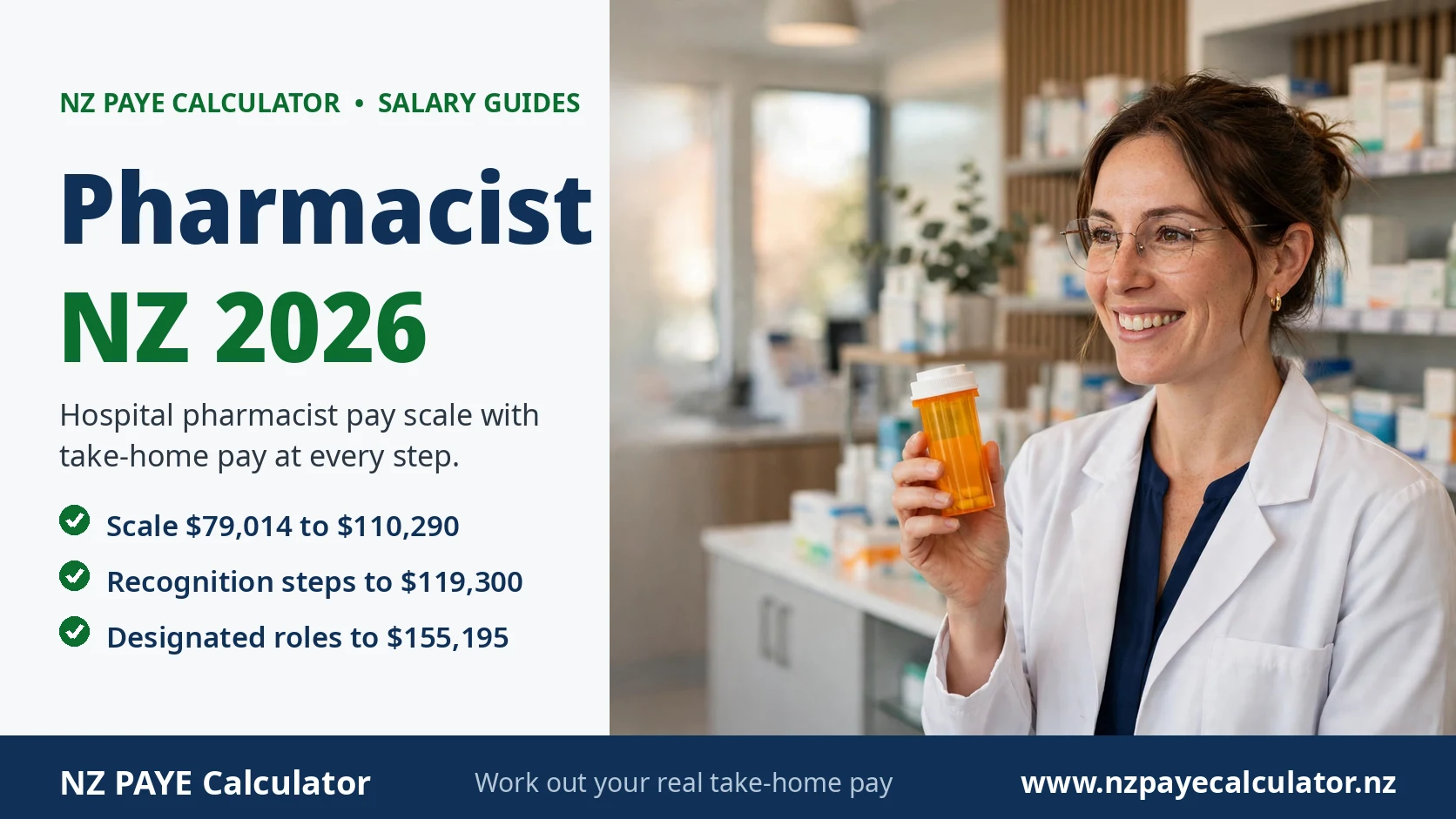
A hospital pharmacist in NZ starts as an intern on $79,014, moves to $84,927 on registration (take-home $65,537 a year), and climbs to $110,290 at Step 7, the top automatic step (take-home $82,087). Merit-based recognition steps reach $119,300, and designated senior and leadership roles reach $155,195. Community (retail) pharmacy has no national pay scale — published averages range from about $40 to $55 an hour depending on the source, covered honestly below.
Hospital Pharmacist Pay Scale (With Take-Home Pay)
This is the core pharmacist scale printed in both the APEX Pharmacy Collective Agreement and the PSA Allied, Public Health, Scientific and Technical Collective Agreement. Step 1 is the intern year; on registration a pharmacist moves to Step 2. Take-home pay uses the 2026/27 tax brackets and ACC levy, M tax code, before KiwiSaver and student loan. The next step-up (+2.0%) lands on 7 December 2026 in PSA districts and 4 January 2027 in APEX districts:
| Step | Salary now | Next step-up | Take-home / year | Take-home / fortnight |
|---|---|---|---|---|
| Step 1 (intern) | $79,014 | $80,594 | $61,679 | $2,372 |
| Step 2 (registered entry) | $84,927 | $86,626 | $65,537 | $2,521 |
| Step 3 | $90,843 | $92,660 | $69,398 | $2,669 |
| Step 4 | $96,754 | $98,689 | $73,254 | $2,817 |
| Step 5 | $102,667 | $104,720 | $77,113 | $2,966 |
| Step 6 | $107,414 | $109,562 | $80,210 | $3,085 |
| Step 7 (top automatic) | $110,290 | $112,496 | $82,087 | $3,157 |
| Step 8 (additional progression) | $112,965 | $115,225 | $83,832 | $3,224 |
| Step 9 (recognition) | $116,133 | $118,455 | $85,899 | $3,304 |
| Step 10 (recognition) | $119,300 | $121,686 | $87,966 | $3,383 |
Designated Pharmacist Roles: Grades A to F
Designated positions are formally established roles with advanced clinical practice, leadership or management duties — team leaders, section heads, professional advisors and clinical leads. Each grade is a range; pharmacists step up within their grade each year, and moving up a grade means appointment to a bigger role:
| Grade | Scale range | Take-home at top of grade |
|---|---|---|
| Grade A | $114,021 – $120,356 | $88,655 |
| Grade B | $120,356 – $125,634 | $92,099 |
| Grade C | $125,634 – $130,913 | $95,543 |
| Grade D | $130,913 – $136,192 | $98,988 |
| Grade E | $136,192 – $142,526 | $103,121 |
| Grade F | $142,526 – $155,195 | $111,387 |
Grade F Step 4 ($155,195, take-home $111,387) is the top of the hospital pharmacist structure, and it is a recognition step. After the next step-up the designated range runs to $158,299.
Two Agreements, Same Dollars
Which agreement covers a hospital pharmacist depends on the district. The APEX Pharmacy Collective Agreement (1 January 2026 – 31 December 2027) is pharmacy-specific and covers districts including Bay of Plenty, Canterbury, Hawke’s Bay, Nelson Marlborough, Northland, Southern, Waikato, South Canterbury, Tairawhiti and West Coast — around 300 pharmacists. Pharmacists in the other districts sit under the PSA Allied, Public Health, Scientific and Technical Collective Agreement (1 December 2025 – 31 October 2027), where pharmacists are on the degree-qualified clinical scale. Both print exactly the same pharmacist dollars; the PSA increases landed on 1 December 2025 and land again on 7 December 2026, while the APEX increases landed on 5 January 2026 and land again on 4 January 2027. One caution: Health NZ’s own careers page quotes rounded bands (core “$81,000 – $122,000”, designated “$117,000 – $159,000”) that blend the current and next columns — the agreement figures above are the exact ones.
Community Pharmacy Pay: No National Scale
Community (retail) pharmacists are not covered by a national collective agreement, so there is no official scale — and the published estimates disagree sharply. Rather than pick one, here are the three main sources side by side, with the full-time equivalent worked out at 40 hours a week:
| Source | Published rate | Full-time equivalent | Take-home on that salary |
|---|---|---|---|
| PayScale (employee-reported) | $39.99 / hour average | ≈ $83,179 / year | ≈ $64,397 |
| Indeed (job ads) | $51.94 / hour average | ≈ $108,035 / year | ≈ $80,615 |
| Jooble (job ads) | $54.78 / hour average | ≈ $105,168 / year | ≈ $78,745 |
Why the gap? The ad-based figures (Indeed, Jooble) reflect what employers offer when they compete for staff — including hard-to-fill and locum-style roles — while employee-reported figures include everyone, including part-timers and new registrants. The honest summary: a community pharmacist’s pay depends heavily on the employer, the region and how hard the role is to fill, and any single “average pharmacist salary” figure should be treated with care. Community intern pay is not published in any reliable source we could find, so it is not stated here.
How Pharmacist Pay Progression Works
- Steps 1 to 7 are automatic: one step up on the anniversary date each year, subject to satisfactory performance.
- Interns move on registration: the intern year is Step 1; completing the intern programme and registering as a pharmacist moves you to Step 2.
- Step 8 is earned, not automatic: progression to the Additional Progression Step requires agreed objectives set in advance.
- Steps 9 and 10 are recognition steps: they reward demonstrated excellence, innovation and leadership, assessed against the agreement’s recognition criteria — only one step movement per year.
- Designated grades: placement is by job sizing; you step up within your grade annually and move grades only by appointment to a higher-graded role.
Penal Rates, On-Call and Registration
- Weekend penal: +T0.5 on weekend hours (in the Auckland districts under the PSA agreement, Saturday pays +T1.0).
- Night penal: +T0.25 for night hours; public holidays: +T1.
- On-call allowance: $8.00 an hour while rostered on call, $10.00 an hour on public holidays.
- Registration costs covered: the Annual Practising Certificate fee is refunded, and under the APEX agreement Pharmaceutical Society (PSNZ) membership is reimbursed up to $470.
Pharmacist Pay Rises: 2025 to 2027
All rates rose 2.5% in the current step (PSA 1 December 2025; APEX 5 January 2026) and rise a further 2.0% at the next step (PSA 7 December 2026; APEX 4 January 2027) — the “next step-up” column in the table above. The PSA agreement expires on 31 October 2027 and the APEX Pharmacy agreement on 31 December 2027, so anything beyond that depends on the next bargaining round.
How to Become a Pharmacist in NZ
The pathway is a Bachelor of Pharmacy (University of Auckland or University of Otago) or the University of Waikato Master of Pharmacy Practice, then an intern year: registration as an intern pharmacist with the Pharmacy Council of New Zealand, the PSNZ EVOLVE intern training programme in an approved site, and passing the Pharmacy Council Assessment Centre (including an OSCE). On passing, you register in the Pharmacist scope of practice and hold an Annual Practising Certificate — renewed every year — which is what places you on Step 2 of the hospital scale.
Work Out Your Own Take-Home Pay
Run any pharmacist salary through the NZ PAYE calculator, or compare professions in the physiotherapist salary NZ guide, the nurse pay scale NZ guide and the doctor salary NZ guide. See also take-home pay for every salary and take-home pay by hourly rate.
Compare Other NZ Profession Salaries
Compare the official pay scales for nurse pay scale NZ, doctor salary NZ, midwife salary NZ, paramedic salary NZ, police salary NZ, firefighter salary NZ, corrections officer salary NZ, soldier salary NZ, social worker salary NZ and physiotherapist salary NZ — every guide works out the take-home pay at each step.
Frequently Asked Questions
How much does a pharmacist earn in NZ?
A hospital pharmacist earns $84,927 to $110,290 on the core scale (Steps 2–7), after starting as an intern on $79,014. Recognition steps reach $119,300 and designated senior roles reach $155,195. Community pharmacy has no national scale; published averages range from about $40 to $55 an hour.
How much does an intern pharmacist earn in NZ?
Intern pharmacists in hospitals are on Step 1 of the collective agreement scale: $79,014 a year, which is $61,679 take-home. On registration they move to Step 2, $84,927.
What is the highest pharmacist salary in NZ?
The top of the hospital structure is Designated Grade F Step 4: $155,195 a year ($111,387 take-home), rising to $158,299 at the next step-up. It is a recognition step within a designated leadership or advanced clinical role.
Do hospital or community pharmacists earn more?
They are paid under completely different systems. Hospital pay is a published scale topping out at $110,290 automatically, with senior roles to $155,195, plus penal rates and on-call. Community pay is set by each employer; ad-based averages suggest experienced community pharmacists can match or beat mid-scale hospital pay, but there is no guaranteed progression.
Do pharmacists move up the pay scale automatically?
Steps 1 to 7 are annual increments. Step 8 requires agreed objectives, and Steps 9 and 10 are recognition steps for demonstrated excellence and leadership — those are earned, not automatic.
What qualification do you need to be a pharmacist in NZ?
A Bachelor of Pharmacy (Auckland or Otago) or Waikato’s Master of Pharmacy Practice, an intern year through the PSNZ EVOLVE programme, passing the Pharmacy Council Assessment Centre, then registration and an Annual Practising Certificate.
When is the next pharmacist pay rise?
The next scheduled step-up is +2.0% — 7 December 2026 under the PSA agreement and 4 January 2027 under the APEX Pharmacy agreement. After that, rises depend on the next bargaining round; the agreements expire in late 2027.
Sources: APEX and Health New Zealand, Pharmacy Collective Agreement, 1 January 2026 – 31 December 2027; PSA and Health New Zealand, Allied, Public Health, Scientific and Technical Collective Agreement, 1 December 2025 – 31 October 2027 (pharmacist scale, clause 5.2); Pharmacy Council of New Zealand — qualifications and training; Health New Zealand, pharmacist careers and job advertisements quoting the agreements. Community pharmacy figures: PayScale, Indeed and Jooble, accessed November 2026 — secondary estimates, not official scales. Take-home figures use the 2026/27 income tax brackets and ACC earner levy published by Inland Revenue and ACC, on the M tax code before KiwiSaver and student loan. General information only, not tax or career advice.